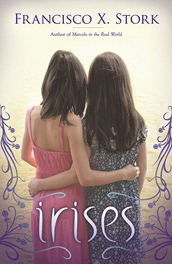
Irises by Francisco X. Stork, 2012
Arthur A. Levine/Scholastic
Rating: 3/5
IQ "Mary smiled. She always smiled when people said living family. It meant that people didn't stop being family when they died; they just turned into your dead family" pg. 144
18 year old Kate wants to be a doctor, 16 year old Mary wants to be an artist. Both girls must put their dreams on hold when their strict father dies, leaving Kate as Mary's legal guardian since their mother is in a permanent vegetative state. Her father told Kate that family always comes first, even if that means Kate needs to hold off on Stanford. Further complicating the matter is that Simon, Kate's boyfriend, has asked her to marry him in order to provide for both her and Mary. Meanwhile Mary is drawn to Marcos, a boy with artistic talent but a violent past. The girls are struggling over the death of their father, accepting their different personalities but what may be the final wedge between them is the decision regarding their mother. They can no longer afford to pay the medical bills keeping her in her vegetative state but she is their mother....
I love Francisco Stork's books. Long time readers of this blog know that, I adored Marcelo in the Real World and was quite fond of The Last Summer of the Death Warriors. Unfortunately I found Irises to be my last favorite Stork book thus far. Granted, this was bound to happen but the summary was so good that my hopes were quite high. All this being said, it was difficult for me to put my finger on why I did not like this book. It just didn't work for me. Part of the issue was that Stork raises juggles so many balls in the air, in a way that I did not find effective. I wish he had stuck to two or three issues (such as the issue of whether or not to pull the plug and how to cope with their new-found independence) and focused on really fleshing out the secondary characters (such as Simon and even Mary). I found the issue of life support inadequately explored, even though I had thought that was at the whole heart of the book. I did find it interesting that the girls (especially Mary since she was younger) did not go crazy or at least engage in more normal teenage acts that their father had previously forbidden. Of course most people don't immediately go party after the death of a parent, but I was surprised that very little mention was made about bigger temptations of Mary and Kate (such as going to the mall, an act their father did not allow).
Both girls seem to be losing their way where their Christian faith is concerned and I felt that Mr. Stork did a good job of subtly addressing the questions that arise when one has a crisis of faith and whether or not you can return to your faith. I also found it really interesting that the author made the girls Protestant. This was a note of interest to me because the girls are Latino and I'm Latino, and I have grown up around mostly Catholic Latinos so I found this new world of Protestant Latinos quite intriguing (of course not all experiences are the same but the book gave me a basic idea). I thought the idea of marriage-as-an-escape was an issue well-explored, even if its a concept many people do not realize is prevalent. Kate was also a great multidimensional character as was the pastor, Andy Soto. I found their interweaving storyline to be the best in the book (it is mostly Kate's story) and very believable.
Ultimately Irises left me indifferent, I certainly don't hate it but I did not love it or even enjoy the book all that much. However the writing is mostly strong, with a few secondary characters left underdeveloped. The book mostly suffers from having too many plots and setbacks occurring. Its strength lies in the simple, effective writing and the realistic dialogue. The issue of faith was portrayed in a respectful, non-preachy manner which made the book more compelling. What did everyone else think?
Disclosure: Mr. Stork kindly sent it to me (a whole year ago I'm ashamed to say). Thank you so very much!
Cover image from Francisco Stork's website
The Quick Guide to Reading in Color
Tuesday, June 4, 2013
Irises
Posted by
MissA
at
6/04/2013 12:30:00 AM
Irises
2013-06-04T00:30:00-05:00
MissA
3/5|book review|contemporary|Francisco X. Stork|Irises|Latino/a|religion|Scholastic|Young Adult|
Comments
Labels:
3/5,
book review,
contemporary,
Francisco X. Stork,
Irises,
Latino/a,
religion,
Scholastic,
Young Adult
Friday, January 11, 2013
Chain Reaction
Chain Reaction by Simone Elkeles 2011 (Perfect Chemistry trilogy #3)
Walker & Company/Bloomsbury Publishing
Rating: 2/5
IQ "If I touch him, I could lose my nerve and let him explain away" Nikki, pg. 225
This is the final book in the Perfect Chemistryy trilogy and my review is spoiler-free (not just for this book but also for the previous 2 books in the series). Luis is the youngest of the 3 Fuentes brothers and unlike Alex and Carlos he has lived a relatively gang-free life. Until he moves back to Fairfield, Illinois the suburb rife with Latino Blood gang members who want him to join and be a leader like his brother Alex used to be. Nikki Cruz is the girl who has captivated Luis, mostly because she won't talk to him or allow him to get close to her. She's suspicious of his Latino Blood associations, she refuses to date LB gang members. Luis doesn't know if he wants to join the LB or no and Nikki doesn't know what will happen if she allows Luis to get close to her
I picked the quote I did not because its majorly inspiring but because I think it captures a key moment in relationships, when you know that the person you're with messed up but that you will forgive them as soon as they 'say the right things' and touch you or hold you a certain way. When really that person needs to forget about 'the right words' and be honest.
Anyway, I love this series and this is the book I was most looking forward to it but it doesn't compare to the first book. Or the second. Its my least favorite in the trilogy and there are a lot of elements about it that I really didn't like. I hated the ending. Not the epilogue, the LB violent ending (and no I didn't not like it because of the violence but because of who ended the violence). I also hated the family revelation. I thought it was a cheap way of shocking the reader and took away some of the appeal of the series. Granted the brothers handled it sweetly but still, it was a completely unnecessary family surprise. Also there wasn't much time spent with the beginning stages of Nikki & Luis' relationship. I totally understand lust-at-first-sight but it didn't stay that way and I wish the author had shown us how they grew to be so close.
I did appreciate the fact that this book is so much different from its predecessors, in ways both good and bad. On the positive end, it was nice to see the girl portrayed realistically as always but also fairly un-Saintlike. The book did maintain its steamy, well-written romance scenes for teens, which are its strong suit. Along with the well-written characters ranging from Nikki & Luis to even minor characters such as Marco, Officer Cesar Reyes and the strong plot and setting of the story. Both Nikki & Luis are extremely headstrong and sometimes this stubbornness causes them to make foolish, prideful decisions. And then they have to deal with the fallout. It does all clean up tidily in the end, but its process and watching the characters try to pick themselves back up and make up for their poor decisions is rewarding and realistic and always refreshing to see.
Chain Reaction had almost all the right elements of being a good story but ultimately for me, two big plot twists ruined the rest of the book. While Chain Reaction bordered on the ridiculous at certain points, I was glad to read about the youngest Fuentes brother and the people in his life, including the fiery-but-not-in-a-stereotypical-way Nikki. I loved that Nikki felt out of place amongst Mexicans even though she's Mexican American, she expressed feelings I definitely emphasized with and recognized. I would still highly recommend this series, the books are fun, hot, a great representation of teenage life (especially in Chicagoland suburbs) and there's never a dull moment.
Disclosure: Received from Lyn. Thank you so much!
Walker & Company/Bloomsbury Publishing
Rating: 2/5
IQ "If I touch him, I could lose my nerve and let him explain away" Nikki, pg. 225
This is the final book in the Perfect Chemistryy trilogy and my review is spoiler-free (not just for this book but also for the previous 2 books in the series). Luis is the youngest of the 3 Fuentes brothers and unlike Alex and Carlos he has lived a relatively gang-free life. Until he moves back to Fairfield, Illinois the suburb rife with Latino Blood gang members who want him to join and be a leader like his brother Alex used to be. Nikki Cruz is the girl who has captivated Luis, mostly because she won't talk to him or allow him to get close to her. She's suspicious of his Latino Blood associations, she refuses to date LB gang members. Luis doesn't know if he wants to join the LB or no and Nikki doesn't know what will happen if she allows Luis to get close to her
I picked the quote I did not because its majorly inspiring but because I think it captures a key moment in relationships, when you know that the person you're with messed up but that you will forgive them as soon as they 'say the right things' and touch you or hold you a certain way. When really that person needs to forget about 'the right words' and be honest.
Anyway, I love this series and this is the book I was most looking forward to it but it doesn't compare to the first book. Or the second. Its my least favorite in the trilogy and there are a lot of elements about it that I really didn't like. I hated the ending. Not the epilogue, the LB violent ending (and no I didn't not like it because of the violence but because of who ended the violence). I also hated the family revelation. I thought it was a cheap way of shocking the reader and took away some of the appeal of the series. Granted the brothers handled it sweetly but still, it was a completely unnecessary family surprise. Also there wasn't much time spent with the beginning stages of Nikki & Luis' relationship. I totally understand lust-at-first-sight but it didn't stay that way and I wish the author had shown us how they grew to be so close.
I did appreciate the fact that this book is so much different from its predecessors, in ways both good and bad. On the positive end, it was nice to see the girl portrayed realistically as always but also fairly un-Saintlike. The book did maintain its steamy, well-written romance scenes for teens, which are its strong suit. Along with the well-written characters ranging from Nikki & Luis to even minor characters such as Marco, Officer Cesar Reyes and the strong plot and setting of the story. Both Nikki & Luis are extremely headstrong and sometimes this stubbornness causes them to make foolish, prideful decisions. And then they have to deal with the fallout. It does all clean up tidily in the end, but its process and watching the characters try to pick themselves back up and make up for their poor decisions is rewarding and realistic and always refreshing to see.
Chain Reaction had almost all the right elements of being a good story but ultimately for me, two big plot twists ruined the rest of the book. While Chain Reaction bordered on the ridiculous at certain points, I was glad to read about the youngest Fuentes brother and the people in his life, including the fiery-but-not-in-a-stereotypical-way Nikki. I loved that Nikki felt out of place amongst Mexicans even though she's Mexican American, she expressed feelings I definitely emphasized with and recognized. I would still highly recommend this series, the books are fun, hot, a great representation of teenage life (especially in Chicagoland suburbs) and there's never a dull moment.
Disclosure: Received from Lyn. Thank you so much!
Posted by
MissA
at
1/11/2013 06:17:00 AM
Chain Reaction
2013-01-11T06:17:00-06:00
MissA
2/5|Bloomsbury|Chain Reaction|contemporary|Latino/a|romance|Simone Elkeles|Young Adult|
Comments
Labels:
2/5,
Bloomsbury,
Chain Reaction,
contemporary,
Latino/a,
romance,
Simone Elkeles,
Young Adult
Monday, January 7, 2013
Male Monday: What You Wish For
What You Wish For: Your favorite authors write to honor Darfur 2011
Edited by Stacey Barney, Foreword by Mia Farrow, stories & poems by Alexander McCall Smith, Meg Cabot, Jeanne DuPrau, Cornelia Funke, Nikki Giovanni, John Green, Karen Hesse, Ann M. Martin, Marilyn Nelson, Naomi Shihab Nye, Joyce Carol Oates, Nate Powell, Sofia Quintero, R. L. Stine, Gary Soto, Francisco X. Stork, Cynthia Voight & Jane Yolen
Ratings: 3/5
IQ "Do you think wishes just happen?" she demanded. "Stars are busy. They can't sit around all day, making every single one of our wishes come true all by themselves. They need a little help from us. I know if I really want a pony, I need to be like you and go out and earn the money to buy one, like you did with your bike." Jenny to her brother, Dave pgs. 55-56
This is an anthology of short stories about wishes, the proceeds go to the UN Refugee Agency, UNHCR.
I liked Jane Yolen's poem "Wishes" and the stories "Reasons" by John Green and "The Rules For Wishing" by Francisco Stork are the best. "Reasons" contains lists after lists and its about Micah, who happens to be in love with Aisha Hussain. Aisha lives in the disputed region of Kashmir, Micah's mother is sponsoring her through For the Children. Its a slightly amusing but really sweet story. There are also photographs throughout the book that may serve as an introduction to the lives of refugee children.
But none of these stories truly stuck with me, I read this anthology awhile ago sometime in the summer and remember few of the stories. I wish there had been a few stories about actual Darfur refugees and the people who work to assist the refugees. Most of the characters in the stories were two-dimensional and very plot-driven. Its perfectly fine for a book to be plot driven but only when the characters are strongly represented and I did not find that to be the case in all the stories.
What You Wish For is worth buying because a few of the stories are excellent and the proceeds go to a worthy charity. Younger readers especially may enjoy these stories.
Another one of my favorite quotes comes from one of my favorites stories, "Reasons"
"I cannot be held responsible for the fact that Aisha Hussain has truly asserting eyes,, and it's important when sitting at my desk doing homework occasionally to be reminded that there are people for whom going to school is not an unbearable burden, but instead an exciting opportunity." Micah, pg. 115
Edited by Stacey Barney, Foreword by Mia Farrow, stories & poems by Alexander McCall Smith, Meg Cabot, Jeanne DuPrau, Cornelia Funke, Nikki Giovanni, John Green, Karen Hesse, Ann M. Martin, Marilyn Nelson, Naomi Shihab Nye, Joyce Carol Oates, Nate Powell, Sofia Quintero, R. L. Stine, Gary Soto, Francisco X. Stork, Cynthia Voight & Jane Yolen
Ratings: 3/5
IQ "Do you think wishes just happen?" she demanded. "Stars are busy. They can't sit around all day, making every single one of our wishes come true all by themselves. They need a little help from us. I know if I really want a pony, I need to be like you and go out and earn the money to buy one, like you did with your bike." Jenny to her brother, Dave pgs. 55-56
This is an anthology of short stories about wishes, the proceeds go to the UN Refugee Agency, UNHCR.
I liked Jane Yolen's poem "Wishes" and the stories "Reasons" by John Green and "The Rules For Wishing" by Francisco Stork are the best. "Reasons" contains lists after lists and its about Micah, who happens to be in love with Aisha Hussain. Aisha lives in the disputed region of Kashmir, Micah's mother is sponsoring her through For the Children. Its a slightly amusing but really sweet story. There are also photographs throughout the book that may serve as an introduction to the lives of refugee children.
But none of these stories truly stuck with me, I read this anthology awhile ago sometime in the summer and remember few of the stories. I wish there had been a few stories about actual Darfur refugees and the people who work to assist the refugees. Most of the characters in the stories were two-dimensional and very plot-driven. Its perfectly fine for a book to be plot driven but only when the characters are strongly represented and I did not find that to be the case in all the stories.
What You Wish For is worth buying because a few of the stories are excellent and the proceeds go to a worthy charity. Younger readers especially may enjoy these stories.
Another one of my favorite quotes comes from one of my favorites stories, "Reasons"
"I cannot be held responsible for the fact that Aisha Hussain has truly asserting eyes,, and it's important when sitting at my desk doing homework occasionally to be reminded that there are people for whom going to school is not an unbearable burden, but instead an exciting opportunity." Micah, pg. 115
Posted by
MissA
at
1/07/2013 05:55:00 PM
Male Monday: What You Wish For
2013-01-07T17:55:00-06:00
MissA
3/5|Alexander McCall Smith|anthology|Cynthia Voigt|Francisco X. Stork|Gary Soto|Jeanne DuPrau|John Green|Marilyn Nelson|Meg Cabot|Middle Grade|Nikki Giovanni|non profits|Sofia Quintero|
Comments
Monday, November 19, 2012
ON HIATUS (INDEFINITELY) due to college
Tuesday, June 5, 2012
Mini Reviews: This Side of the Sky, Passing Love & Paris Noire
This Side of the Sky by Elyse Singleton 2002
Bluehen Books/Penguin
IQ "Old people used to say there comes a time when you remember fifty, sixty years ago as if it were last week, but damn if you can remember last week at all. They were right. Every generation thinks their time is the time and talks about the resent as if it's some stable territory they can occupy indefinitely. Yet when we say now, by the time we get to the w sound, the n is in the past." Lilian, pg. 8
Lilian Mayfield and Myraleen Chadham grew up in Nadir, Mississippi and they've been friends since they were babies. Nadir soon grows too stifling for both of them, Lilian wants a great education which she can't receive in the segregated South and Myraleen wants an adventure. Circumstances soon arrive that make it prudent for them to leave town and they travel about from Philadelphia to joining the Army and serving in England and then settling down in post WWII Paris for awhile. They struggle financially, learn about love and suffer through some trying times and tough losses, but they always, always, have each other.
This book took sooo long to get started. I was hoping the girls would run away soon but it felt like it took them forever to decide to leave Mississippi and even then it wasn't really of their own free will. I also felt that parts of the story were implausible and while I was happy that some things occured, other events happened that seemed too coincidental so overall I'm going to say the book could have been more realistic to life. Furthermore I would have liked to get the perspective of August or some other guy to balance out the trio of Lilian, Myraleen and Kellner (a German POW).
I loved the character of Myraleen, she's a spitfire uttering statements like "once I hate a bastard, I hate him forever. I guess I'm just loyal that way" (pg. 68), who wouldn't love a character like that? I also really liked Lilian, her quiet strength spoke volumes louder than Myraleen's tough dialogue. They have a beautiful friendship from the very beginning and the core of the book, the best part-next to the characters of the cities they pass through-is their enduring friendship that goes through some bumps but always heals. I also loved Mudear, Lilian's mother. Tough as nails but super sweet as well and even though she didn't finish her high school education she's still whip-smart. It's funny, one exchange between Mudear and Lilian stands out for me because it holds truths that still apply today. "Mudear read aloud anything she saw about colored people. 'See there', she'd say. 'Negro Holds Up Store. That's why we can't get anywhere. We don't know how to act.;
'But, Mudear,' I said. 'plenty of white people stick up stores, rob banks. And you don't see a headline saying 'White Man Robs Bank'.
'Got a point. [...] See, that's why I sent you to school, so you could think. Not too many folks can think. A lot can only talk. Better if it was the other way around" (pg. 81).
The historical details were intriguing as well, especially learning about German POWs. I didn't know German POWs were lent out to farms in America and I didn't know how bad the Russians treated them. This book provided a more humane look and reminds readers not all Germans were Nazi, something that should strike people as obvious and yet it still bears repeating.
This Side of the Sky is not overpowered by the strong personalities of the places Myraleen and Lilian visit, instead the dominant aspect is the friendship of the girls. They have different dreams but they also want the best for each other and are willing to sacrifice themselves for the other to ge a chance at her dreams, at her own sense of happiness. An attitude like that can only end in good things. The historical details about the treatment of German POWs and the discrimination Black women faced in America and while serving their country in the UK (of course the discrimination was from our own Army, not the English people) during WWII are vividly portrayed. The book is very thourgh in all its description, no detail is too small to be touched upon and while I didn't appreciate that quality in the beginning of the book, my patience paid off.
PS Another favorite quote that lightly touches on Paris aging too "Paris is changing. Pavement replaced cobblestones after students used them to pelt police in the '60s riots. McDonald's arrived in the '70s. Right-wing machinations and Third World immigration have strained the racial climate. Yet the core city is much the same. It's a comfort to grow old in a place that's so much older ,where even the light posts appear to understand. It must be so hard to age in America. A city block can be unrecognizable from one decade to the next, because the cheap plaster and plastic keep getting replaced by new cheap plastic and plaster." pg. 323. Food for thought, I'm going to retire somewhere like the Paris she describes, it may even be Paris!
Grand Central Publishing/Hachette Book Group
IQ "But I will tell you this-adventure is only a word. Don't be so fixed on findng, live and in that the adventure will come." Ruby, pg. 296
Nicole-Marie Roxane Handy has a serious case of Francophilia but until the death of her dearest friend she hadn't had the courage to visit Paris on her own. The death of her beloved friend kicks her butt into gear and she heads to Paris, leaving behind her Alzheimers-ridden father, her mother who is now more of a caretaker than a wife, and the marriage proposal from a man who is married. While exploring Paris Nicole finds an old photo of her father, he never spoke about his time studying in Paris and he doesn't remember it anymore but the photo is inscribed to a beautiful young woman who is not Nicole's mother. Nicole grows determined to discover the identity of this young woman and her connection to Nicole's father.
We learn that the young woman is Ruby and she alternates chapters with Nicole. Ruby lived in Paris in the 1950s and my-oh-my it was a glorious time. Jazz clubs were beginning to open and there was a solid community of Black Americans. Towards the end the book does drag a bit. But it's ok because I wasn't ready to leave Paris just yet anyway. It does start off slowly but again I was content to meander through Paris with Nicole, but I did get bored with all the Mississippi parts (that's where Ruby was from. I feel like its always the same family issues with books set during the 1920s-40s about teenaged girls in small towns, they wanna go off and explore but their super-protective mothers stifle them until they runaway. Eh-yawn). Also while I loved Arnett, I didn't understand his relationship with Ruby. The author started off seeming like one way and then all of a sudden Ruby & Arnett were pledging eternal devotion to each other, it came out of the blue since I was convinced he was going to drop her any minute.
I liked Ruby, I may be one of the few people who actually liked her. I didn't mind that she was selfish and at times downright unlikable, she had spirit and as Nicole observes "a flash of that young, willful woman who dared to change her destiny. Reality hadn't met Ruby's expectations; she took what she could and stayed with it" (pg. 286). I do not love Ruby due to her current lifestyle but I respect her attitude towards life and I admire her resilience, she was devoted to Paris and everything French. She learned the language and the mannerisms, she learned about the entire culture and that must have been very hard to do living on a shoestring budget and constantly having to work. Plus Ruby knew her flaws. She didn't try to change them but she didn't try to conceal them either, in her old age she is comfortable with who she is and she makes very few apologies. Ruby is quite a character and I would love to meet her. Her advice she gives that I included as my Incredible Quote is excellent and something that makes complete sense but I feel like many people don't know that little bit of wisdom. It's one of my favorite book quotes, hands down. Living life is an adventure, no need to go search one out (that's ok too but people shouldn't feel like failures if they haven't had some grand adventure as long as they still took risks). Nicole didn't have as much of a lasting impression on me as Ruby did but I didn't dislike Nicole. I found her a bit boring at first simply because I never understand why people are afraid to travel but I grew fond of her too. I thought it was a good choice for the author to make Nicole 56 and show that it's never too late to have romantic travel flings (or serious relationships ;) The details about Black people in Paris and life in Paris in general during the 1950s are exquisite.
Passing Love features lovely romances with surprising twists and adds a fresh spin to the classic tale of discovering one's past. It becomes immediately clear that this is not the average coming-of-age-by-discovering-family-secrets story simply based on Nicole's age and the way she goes about her search. I loved the title, its deceptively simple. As the story develops so too does the title, taking on many different meanings. I firmly intend on buying this book as my own reminder to visit Paris, when I do I intend on visiting all the places mentioned, exploring Black Paris. A new favorite.
IQ "She lapsed into the patois that was Martinique because it allowed her to relax into herself. She could speak proper French if she took a mind to the task. It wasn't even difficult. After all, it was De Gaulle's French she spoke every time she left her apartment and strolled the winding streets of Montmarte. Even General LeClerc could speak no better French than she when she taught her sixth grade class. Not that those ruffians from Morocco, Senegal and Algiers would know the difference anyway. She sighed. Who was she to think such thoughts? Wasn't she born and bred in Martinique, herself?" Marie Therese pg. 2
It's the liberation of Paris! The year is 1944 and Marie-Therese Brillard and her children Collette and Christophe are swept up in its exciting aftermath. They each find romance but with very different people. Colette with a white Frenchman, Christophe with the married wife of a Free French fighter and Marie Therese with Monsieur Lieutenant, a Black American soldier. These romances will not all end in happily ever-after....
I chose that little paragraph as the Incredible Quote because its one of my favorite parts (obviously) because it provides some insight into the time period and Marie Therese's frame of mind without being direct. But it also illustrates a characteristic of this novel that I detested and that is "oversharing". The reader already knows based on the first sentence in that paragraph that Marie Therese has some connection to Martinique. There could have been a better way to make it clear that she was born and raised there then by having the speaker REMIND herself where she grew up. Something as simple as "Who was she to think such thoughts, she an immigrant herself?" And then obviously the reader would think 'huh since she speaks in the patois of MARTINIQUE than that's where she must be from'. Thus the awkward sentence that ends the paragraph in the IQ has been avoided. Sadly that happens a lot throughout this book, characters practically hurt themselves trying to show off their knowledge about WWII and the events occurring in their country. The problem is, they repeat things to other characters that they should have already known. I get extremely annoyed when authors use characters as history teachers, i.e. they spout off facts or ask dumb questions that HISTORICALLY they would have already known the answer to. Here's an example, "Collette. Maman. The sentries. The ones that always march by the boulangerie at least twice a night to make sure we're all inside the bakery and not sneaking out to help the Resistance. They...." (pg. 6). Why not just send at "The sentries"? Because Marie-Therese and Collette should already know what Christophe is talking about, the author should be able to find another way to explain what German sentries do in Paris than just carelessly insert it in Christophe's dialogue. 'Oversharing' (as I call it) like this happens throughout the duration of the book. Another issue I had with this book is Collette. I'm not sure why the author even included her. If you read the back cover. you would think the story is told in alternating points of view or that at least Collette gets some story time. Nope. She's simply a vehicle for the mother to wax on and on about the dangers of dating outside the race. BUT WE LEARN NOTHING ABOUT COLLETTE. This infuriated me because she was mentioned all the time but I finished this book unable to even tell you the name of her Frenchman. It would have been nice catch a glimpse of their romance. Especially since it was never clear to me if they would have faced prejudice, my guess is no but that's based on other books I've read about the French treatment of Black people (see above reviews) I wouldn't be able to back that guess up based on only reading this book.
Even though the book did a terrible job of presenting historical information, I loved the scenes at Glovia Johnson's house. She's a beautiful, wealthy, glamours, seductive Black American woman living in France and she hosts salons at her homes, both Blacks and whites visit her legendary salons. They seemed like a lot of fun and Glovia Johnson was my favorite character because she was at least interesting. The rest of the characters were spineless, except for Marie-Therese who had some backbone but was drab. Glovia Johnson literally plays the field, as in she bed with German soldiers and influential French people depending on whose in power in order to keep up her luxe lifestyle. She has little shame but that's ok because she's very sweet and clever. I do not want to just complain about the IQ, I also chose it because it provides a glimpse at how people viewed Black immigrants which was a perspective I found fascinating since it is rarely discussed. Immigrants from the Caribbean looked down on Black Africans as did white French, but the white Frenchmen(and women) loved Black Americans. "Marie Therese struggled to hide her nervousness. Her French had to be correct even though this American spoke with the most atrocious accent. That is, when the chanteuse bothered to speak French at all. Still, she was one of them, and all Paris loved that accent coming out of the mouths of America's black emigres. If only it were so for the Africans and West Indians" (pg. 11), sentences such as those made me appreciate the book a little bit more.
Paris Noire does a service to the world of historical fiction (and books as a whole) because it talks about a time period that most people are very familiar with but offers a perspective that has not been explored. The lives of Black people in France before, during and after WWI all the way to the 1950s has always intrigued me since they faced so little discrimination. But this book points out that French love for Black people only extended to Americans. The book was very disappointing but I had high hopes for this book and that was part of the problem. Perhaps if my hopes had not been so high I would have liked it better as fluffy-tragic romance novel. Instead I expected some intense, lightly romantic, in-depth historical fiction. The fact that the character of Collette was completely ignored bothered me immensely as did the tendency of the author to have her characters speak awkward dialogue simply to provide historical information. I wish it had been about Glovia Johnson instead. It was just ok.
Disclosure: Bought
Posted by
MissA
at
6/05/2012 10:34:00 PM
Mini Reviews: This Side of the Sky, Passing Love & Paris Noire
2012-06-05T22:34:00-05:00
MissA
adult fiction|African Americans|Black people|book reviews|Elyse Singleton|France|Francine Thomas Howard|historical fiction|Jacqueline Luckett|mini-reviews|
Comments
Wednesday, March 28, 2012
Literacy Around the World: College Essay Style
*This is basically a filler post but the ideas I touched on in this essay (250 word limit) are ones that I hope to expand upon further on this blog and in the comments section of other people's blogs. I adamantly believe that one of the best ways to increase literacy rates is by having more diversity in literature whether its via a) characters from cultures all over the world, b) translating classics/adult fiction/young adult/childrens books in the native language into English for Western audiences and c)investing in local authors and for publishers to help them foster their talent and create a market for more YA/childrens/adult books in the particular country.
Initially, the room made my bookworm heart swell with joy. The bookshelf was piled with books, there were cozy-looking chairs, but to my dismay all the books at the women’s center were in English. The center is located in San Lucas Toliman, a small town in Guatemala and no one speaks English. I visited this women’s center during my summer service trip to Guatemala. I realized that while it is wonderful to donate books; we need more books written in native languages. In developing countries, writing as a profession is not an option. In countries where people are struggling to meet their basic needs, it is important to develop and preserve their culture through writing. Publishers must encourage and compensate aspiring writers. There are currently few programs in these countries to foster literary talent. By publishing translated works and works by native authors, publishers will expand their outreach and reach new consumers. Children are more likely to be interested in reading a story with a protagonist who shares a similar cultural background which creates a deeper connection.
The literacy organization Room to Read has an excellent initiative known as their Local Language Publishing programs. Its founder John Wood has said “We are seeking the Dr. Seuss of Cambodia.” We need more programs like this to publish and distribute books written in a variety of languages that are easier for children to connect with. We also need more translated books and publishers willing to take on this project by investing a little more money than usual. I love reading and I want everyone else to have the same passion for literature that I do. Reading teaches tolerance and encourages readers to use their imaginations. These qualities will enable our future leaders to think of creative solutions for the problems facing society. I dream of the day when everyone can see their culture reflected within the pages of books and be able to proclaim themselves bibliophiles in their own language.
To see if I got in to a certain school based on this essay, highlight to read (haha): NO =/ But I'll survive. Any recommendations of excellent translated books? Ideas on fun ways to improve literacy around the world? Am I way off with my ideas? Do tell! I promise I read your comments and reply to them in my head, I just have a hard time remembering to reply online sometimes (:
Initially, the room made my bookworm heart swell with joy. The bookshelf was piled with books, there were cozy-looking chairs, but to my dismay all the books at the women’s center were in English. The center is located in San Lucas Toliman, a small town in Guatemala and no one speaks English. I visited this women’s center during my summer service trip to Guatemala. I realized that while it is wonderful to donate books; we need more books written in native languages. In developing countries, writing as a profession is not an option. In countries where people are struggling to meet their basic needs, it is important to develop and preserve their culture through writing. Publishers must encourage and compensate aspiring writers. There are currently few programs in these countries to foster literary talent. By publishing translated works and works by native authors, publishers will expand their outreach and reach new consumers. Children are more likely to be interested in reading a story with a protagonist who shares a similar cultural background which creates a deeper connection.
The literacy organization Room to Read has an excellent initiative known as their Local Language Publishing programs. Its founder John Wood has said “We are seeking the Dr. Seuss of Cambodia.” We need more programs like this to publish and distribute books written in a variety of languages that are easier for children to connect with. We also need more translated books and publishers willing to take on this project by investing a little more money than usual. I love reading and I want everyone else to have the same passion for literature that I do. Reading teaches tolerance and encourages readers to use their imaginations. These qualities will enable our future leaders to think of creative solutions for the problems facing society. I dream of the day when everyone can see their culture reflected within the pages of books and be able to proclaim themselves bibliophiles in their own language.
To see if I got in to a certain school based on this essay, highlight to read (haha): NO =/ But I'll survive. Any recommendations of excellent translated books? Ideas on fun ways to improve literacy around the world? Am I way off with my ideas? Do tell! I promise I read your comments and reply to them in my head, I just have a hard time remembering to reply online sometimes (:
Posted by
MissA
at
3/28/2012 08:38:00 PM
Literacy Around the World: College Essay Style
2012-03-28T20:38:00-05:00
MissA
Comments
Tuesday, March 13, 2012
The Agency: The Traitor in the Tunnel
Candlewick Press
Rating: 4/5
IQ "All the feelings she had long suppressed overcame her at last, making her stagger. It was like a physical blow: she not just alone, but lonely. The solitary sate was nothing new, of course. But she was lonely now for different reasons. She was lonely despite the possibility of family-perhaps because of that very likelihood. Because she might not be absolutely truly alone, after all, and she might have preferred it so." Mary pg. 98
Mary Quinn is officially an agent and she is determined to do exceptionally well on her first assignment. To her dismay, she is given a "boring" case in which a petty thief is stealing inconsequential things from Buckingham Palace. Mary is placed as a maid in Queen Victoria's court in order to prevent any future thefts and discover the identity of the thief. But while Mary grows impatient with her case another arises when the Prince of Wales witnesses a murder in an opium den. The queen does not want him to testify due to the scandal and Mary's interest is piqued further when she learns that the accused killer may be someone she is quite familiar with.
Compared to the other two books, this one left me disappointed in terms of the mystery. The mystery element seemed to be completely disregarded at times. Worse, the conclusion was random and anti-climatic. It was not nearly as exciting or interesting as I had hoped. I read this as though it would be the final book in the trilogy (it was originally supposed to be a trilogy and it is the 3rd book) so perhaps that explains some of the ambiguity in terms of the motives of certain characters (lady-in-waiting, Octavius Jones, Anne & Felicity). Nevertheless I am still baffled as to why the criminal(s) committed the crimes that they did.
I chose the quote I did because I can relate to not necessarily wanting company, to preferring being alone but not lonely. But what this book lacks in terms of mystery development, it more than makes up for it on the romance front. James & Mary have the most engaging of exchanges, especially at the end. They both have a wry sense of humor, stubborn nature, a love of adventure and a belief in fairness for all. They make a wonderfully exasperating team which makes the storyline all the more fun. I was thrilled that we finally learned more about Mary's past, this is when new twists are thrown into the story and everything untangles in a way that makes sense. As always the best part of the book is Mary Quinn herself (with Mary&James a close second). Mary is extremely resourceful, it is amusing to see how frustrated she gets with this case in which no gossip is allowed at the palace, thus how is she to discover information? Never doubt that Mary Quinn will find a way to obtain the information she wants. Mary's resilience is inspiring, and I love the author's focus on her working-class origins as well as the daily life of other working-class people. I think many historical novels today want to focus solely on the wealthy or upper middle class, it's nice to see a book that does not shy away from describing the poverty of Victorian England and the grinding lives of the English and immigrant working class.
I needed a lovely historical fiction read, one that reminded me of why I loved studying history so much and The Traitor in the Tunnel more than delivered on that front. I appreciated the personal glimpses of Queen Victoria when she was not playing her role as THE QUEEN, instead the author paints a portray of a Queen Victoria who bore a great weight on her shoulders but who also loved her family and lots of laughter, she had a mischievous spirit. I felt that this book in the series spent more time explaining things but not in a boring manner, rather the author finds ways to cleverly insert historical or tactical information into the story (or blink-and-you-might-miss-it). One of my 'complaints' (not really I complaint since I LOVED the second book) was that I wanted to know more about The Agency and gradually more details are being revealed in this book. James Easton is infatuated with Mary Quinn as am I. This is a series that I cannot praise enough, I wish every world/European history class had at least one of these books as required reading.
Disclosure: Received from the author as part of the Candlewick Blog Tour. Thank you so much for including me Ms. Lee & Candlewick! Please read the guest post (very prevalent to the book) about opium as a Victorian obsession
Posted by
MissA
at
3/13/2012 09:44:00 AM
The Agency: The Traitor in the Tunnel
2012-03-13T09:44:00-05:00
MissA
4/5|Asian|book review|Candlewick|historical fiction|The Agency series|Y.S.Lee|Young Adult|
Comments
Labels:
4/5,
Asian,
book review,
Candlewick,
historical fiction,
The Agency series,
Y.S.Lee,
Young Adult
Monday, March 12, 2012
Literacy Organization Spotlight: Gone Reading
Recently I was emailed by Gone Reading International asking if I would be interested in receiving a coupon for my blog readers. I checked out the website and I really support their mission. Gone Reading International sells bookish things (everything except books) such as book lights, book journals, bookmarks, book-related games and boo
k-related T-shirts. The coupon code is READINGINCOLOR25. Expires April 11 (the coupon)!
To the left is my favorite T-shirt, it says Take Me to Your Reader :)
But this post is not meant to be free ad-space rather I love that Gone Reading International donates 100% of our after-tax profits to provide new funding for libraries and reading-centered non-profits. By purchasing GoneReading brand gifts and merchandise, you’re treating yourself and the world at large to a wonderful gift. All purchases from GoneReading help contribute to our philanthropic work. In the Developing World we donate to great non-profits such as READ Global and Ethiopia Reads, amazing organizations with proven models, long track records, and dedicated teams on the ground. Such groups partner with local villages and communities in the most underdeveloped parts of the world to create new libraries that effect real change.In the United States, Canada, United Kingdom & AustraliaGoneReading is currently piloting a fundraising program to raise money for public libraries and reading-centered non-profit organizations within the U.S. Details are still pending. Although our company just started in 2011, our goal is to provide significant financial assistance to libraries around the world, allowing them to achieve greater scale and impact."
They also have a blog and book suggestions. Check it out and be swayed to buy something proclaiming your love of books (besides a book) while helping provide opportunities for future book lovers!
Posted by
MissA
at
3/12/2012 11:15:00 PM
Literacy Organization Spotlight: Gone Reading
2012-03-12T23:15:00-05:00
MissA
for profit|Gone Reading|literacy|
Comments
Labels:
for profit,
Gone Reading,
literacy
Saturday, March 3, 2012
Victorian Obsessions Blog Tour with Y.S. Lee
I am a day late with this post which is mortifying. I will do better! Anyway I am ecstatic to re-introduce the wonderful author Ying Lee. Her The Agency trilogy, is one of my favorite trilogies and her final book, The Traitor in the Tunnel keeps the awesomeness rolling. In fact it's my favorite book in the series (but I said that about the second book too and I love the first book so don't listen to me ;) Y.S. Lee has written guest posts for me before and I love them because they are about history but it's history that probably won't be in your textbook (unless you have a really cool textbook that talks about notorious Victorians, Victorian obsessions and weird facts about Victorians). Read on!Victorian Obsession: Opium
What do you think of when I say, “opium”? Poppies, addiction, maybe the British Empire or hookahs? Well, what about babies? Let me explain.
Opium was, of course, one of the great money-spinners of the British Empire. The British grew opium in British East India and sold it in China, where there was huge demand for it. That’s why the stereotype of the opium-addict is often that of a gaunt Chinese man lying beside a hookah. But, as with all stereotypes, that’s only part of the picture.
Opium use was totally unregulated in England until the Pharmacy Act of 1868. This means that the first half of the nineteenth-century was basically a free-for-all in terms of drug use: anyone could sell it, and anyone could buy it. And as in China, opium merchants in England did a roaring
trade.
trade.
One of opium’s most popular uses was in an alcohol tincture called laudanum, popularly used to calm the nerves, help sleep, and generally soothe the user. It was considered totally respectable, so ladies as well as gentlemen felt free to take it – and that’s what the British did, in vast quantities. And since opium was so effective and pleasant for adults, they also gave it to children.
Some of the widely marketed “soothing syrups” for infants in the early nineteenth century were mixtures like Godfrey’s Cordial, which was made of opium, water, treacle (a sweetener), and spices. Other brands included Steedman’s Powder and Atkinson’s Royal Infants Preservative. These were immensely popular for use with ill babies. It makes sense: when children are ill, parents want them to feel better. Opium lessened the pain, and the sweetness of the syrups made sure the babies accepted them.
Obviously, opium syrups were not good for babies. Even ignoring questions of addiction and brain development, babies given frequent doses of these syrups tended to be small and stunted, and were often described as “wizened”, or looking like little old men. The reason? They were too sleepy to eat, and became malnourished as a result.
It’s impossible to know how many babies died of starvation as a result of opium syrups. But during the mid-nineteenth century, doctors suspected this was the case. Opium syrups were popular not just with parents of sick infants, but also unscrupulous nurses (who wanted children in their care to sleep a lot) and working-class parents (who were too exhausted from long working hours to deal with fussy babies). These are the most difficult deaths to trace, although it didn’t stop people from speculating.
And this is the double standard of Victorian opium use: you could sit in your elegant drawing-room and denounce the sinful ways of Chinese opium addicts, lazy nurses, and the working poor, all while sipping a glass of sherry-and-laudanum to help you get a good night’s sleep. It’s a bitter irony. Rather like the taste of laudanum itself.
Depressing topic? Um yes. Fascinating? Very! Thank you so much Ms. Lee
Posted by
MissA
at
3/03/2012 09:17:00 PM
Victorian Obsessions Blog Tour with Y.S. Lee
2012-03-03T21:17:00-06:00
MissA
guest post|Y.S.Lee|
Comments
Labels:
guest post,
Y.S.Lee
Sunday, February 26, 2012
New Crayons (FINALLY) + Future Post Ideas

New Crayons is a meme hosted by Color Online in which participating bloggers share what new books they got for the week whether by buying them, going to the library, trading or as gifts.
Except for one, these books all have one feature in common that makes me happy. Guess what it is.
I've been thinking lately about what I want to write about on this blog. I've got plenty of books to review and I am slowly (but surely) finding the motivation to resume reviewing. I am open to suggestions; is there anything people would like to see me discuss? Or answer any questions? I have a few ideas but I am open to any others. For now I know that I want to write the following sometime soon (as in before I go to college):
-resume my monthly literacy non-profit spotlight
-Write a follow-up Jane Austen post (and respond to all the comments)
-Read/review books about one country for one week in which there is a humanitarian crisis occurring (a la my Haiti week)
-Publish my before-college bucket list
-write a 2012 MG releases about kids of color post (a la my 2012 YA releases about teenagers of color)
For those who are curious about my colleges so far I was accepted into Tulane University, University of Rochester, Loyola University Chicago, Fordham University and Northeastern University. If you have any thoughts on any of those colleges, feel free to share them since I have an idea of where I want to go but I'm not 100% sure yet. And I hear back from a few others in late March.
Now for my New Crayons (most of the books arrived weeks ago)
Ship of Souls by Zetta ElliottRelease Date: Feb 28
When 11-year-old Dmitri (D) loses his mother to breast cancer, he finds himself taken in by an elderly white woman, Mrs. Martin. D loves to watch birds and, while in the park, is amazed to find an injured bird that can talk. He takes it home and soon learns there are malevolent forces inhabiting the region beneath Prospect Park and they are hunting for the bird; Nuru is a life force that has been kept hostage by the earthbound spirits who are ghosts of soldiers that died in the Revolutionary War. Nuru's mission is to guide the ship that will carry the souls of the dead back to her realm. D has been chosen as Nuru's host, and must carry the bird from Brooklyn to the African Burial Ground in lower Manhattan where the dead await deliverance.
-Thank you so much Zetta and congratulations on the Booklist starred review! Zetta Elliott is one of my favorite authors after reading her debut, A Wish After Midnight so I'm impatiently waiting for school to settle down so I can devour this book.
Cat Girl's Day Off by Kimberly PauleyRelease Date: April 1
Natalie Ng’s little sister is a super-genius with a chameleon-like ability to disappear. Her older sister has three Class A Talents, including being a human lie detector. Her mom has laser vision and has one of the highest IQs ever. Her dad’s Talent is so complex even the Bureau of Extra-Sensory Regulation and Management (BERM) hardly knows what to classify him as. And Nat? She can talk to cats. The whole talking-to-cats thing is something she tries very hard to hide, except with her best friends Oscar (a celebrity-addicted gossip hound) and Melly (a wannabe actress). When Oscar shows her a viral Internet video featuring a famous blogger being attacked by her own cat, Nat realizes what’s really going on…and it’s not funny. (okay, yeah, a frou-frou blogger being taken down by a really angry cat named Tiddlywinks, who also happens to be dyed pink? Pretty hilarious.) Nat and her friends are catapulted right into the middle of a celebrity kidnapping mystery that takes them through Ferris Bueller’s Chicago and on and off movie sets. Can she keep her reputation intact? Can she keep Oscar and Melly focused long enough to save the day? And, most importantly, can she keep from embarrassing herself in front of Ian? Find out what happens when the kitty litter hits the fan.
-The words "Ferris Bueller's Chicago" made me fall in love with this book's summary, can't wait!
Team Human by Justine Larbalestier & Sarah Rees BrennanRelease Date: July 3
When a vampire shows up at Mel's high school, it's up to Mel to keep her best friend from falling in love with him. Add a mysterious disappearance, a cranky vampire cop, a number of unlikely romantic entanglements, and the occasional zombie, and soon Mel is hip-deep in an adventure that is equal parts hilarious and poignant.
-Both authors are hilarious and great writers, what more could a reader want?
Into the Wise Dark by Neesha MemingerRelease Date: March
Pammi has a Secret--she is an Able. At night, she travels through time to an ancient city called Zanum. She's been visiting Zanum since she was seven and she's kept it a secret from everyone--including her own mother. Especially her mother. Everything's been fine...until now.On the night of an important Zanum ceremony, Pammi follows her gut instinct and defies an elder's orders, inadvertently leading evil directly to the door of the city she loves. Now the evil that plans to wipe out the city is coming after her. Can she save herself, and Zanum, before it's too late? Or will she seal the doom of all Ables and witness the annihilation of everyone she loves?
-I love all the cool links related to the book the author features on her website, I'm a sucker for research and historical tidbits. Again Neesha Meminger is one of my favorite authors so I'm dying of anticipation :D
What books did you get this week? Share the titles. Have you read any of the books I got? What posts would you like to see me write?
Monday, February 20, 2012
Male Monday: Cracking the Ice
Cracking the Ice by Dave Hendrickson 2012Westside Books
Rating: 3.5/5
IQ "No one had said a word in his defense. No one had lifted a finger. No one. Jessie thought of a phrase Pop often used: No snowflake in an avalanche feels responsible. He hated all of them, every snowflake on the hockey team. Yet he couldn't very well give up, could he? Doing that would rob him of his dreams and give them what they wanted." pg.153
Jessie wants to play hockey, eventually making it to the NHL. It's not a problem per se, but it will be a battle because Jessie is growing up in the 1960s and there was only one Black professional hockey player at this time, Willie O'Ree for him to look up to. Jessie is offered the opportunity to attend a prestigious New Hampshire boarding school on a full scholarship and the chance to play on the school's hockey team. Best case scenario Jessie hopes he will get spotted by scouts and be on his way to the NHL after a grand college career, worst case scenario, Jessie plays for one of the best high school hockey teams in the country and attends a top college. He sees this situation as a win-win and although his parents have some serious misgivings, they ultimately agree. Unfortunately, Jessie expected some racism but he is shocked by the racism he faces from 99% of his teammates, he expected his teammates to come around when he showed his skills. Jessie does not want to throw in the towel, but he's not sure he wants to spend four years of his life being miserable, and not given playing time by his hockey coach.
I don't have many problems with this book, I didn't love but it was not a waste of my time. In fact, I think it's one of the most interesting books I've read this year. And it touches a subject close to my heart. But first a few quibbles. Jessie has a girlfriend, they are in love. Jessie is fifteen. I thought this would be one of those 'first-love but move on' type stories but it's not which I felt was unrealistic. But then again, it was the 1960s, maybe people fell in love and stayed together at an earlier age. *shrugs* I also did not like the ending because I felt like it made the whole story pointless. I can't explain it without going into spoilers but while it wasn't completely depressing, I did feel like the ending made the whole premise unnecessary. Furthermore, I really really liked the focus on hockey but I was curious as to how Jessie was doing academically. Were his classmates just as racist? His teachers? There are a few dorm incidents but it was never clear to me if Jessie's teachers and classmates were all narrow-minded.
My father loves hockey. My father is Panamanian American so this is not exactly "normal". I am not going to pretend I watch hockey avidly because I don't have time to watch sports everyday but some of my earliest memories of father-daughter time is me lying on my father's stomach as we watch a hockey game, usually the Blackhawks versus whoever. I watched all the Stanley Cup playoff games last year and I would venture a guess that I know a little more about the Blackhawks than most bandwagon fans after our 2010 win. But whenever I hear someone talk about hockey, I think about my father. Especially because we often discuss the few Black players in the NHL and usually, if the BHawks aren't playing, we support whichever team has a Black player (if they both have Black players on their teams, great. Then it's just based on talent). My father has told me that he gets some ribbing from his friends for liking hockey and the few times I mention I like hockey, I get some weird looks (and Black people usually tell me that it's a "white sport" to watch and play). I found it interesting that the author chose to give the book a 1960s setting when this book could have been even more interesting set in the present-day. Cracking the Ice did not, I felt, do a good job of explaining why many Black Americans do not play hockey. It's mostly an economics issue and I would venture a guess that this held true in the 1960s as well as today plus I am sure there are still racial incidents today. I was also curious as to how Jessie became a fan of hockey, that was never explained. If it was because he grew up in the Northeast where hockey is hugely popular, than the book should have explained why other Black teenagers were not interested in hockey. The descriptions of hockey however are delightful. The author clearly has deep-rooted affection for this sport and it shows in the detailed dialogue and descriptions of hockey greats, hockey plays and the euphoric highs one gets playing this often-brutal, skilled, sport.
Cracking the Ice is noteworthy because it is a one-of-a-kind book, it takes the civil rights movement to the hockey arena and it handles the subject nicely. The racism is disgusting and difficult to read about, it's always scary to play with racist teammates but especially in hockey because it is a team sport and violence is involved and so as Jessie points out, you need to know your teammates have your back. If they are too bigoted to protect their own teammate solely because of his skin color, that's a serious problem. I think the author does a great job conveying the determination not just of Jessie but of Black people in general in the 1960s to follow their passions even though many white Americans tried to dissuade them. This story skates by and at times I grew genuinely nervous for Jessie. I also appreciated that the story showed how hockey evolved by explaining the safety measures, helmets were a recent thing which is scary to think about. Jessie and his roommate Stick, the only other Black student at the school, present two examples of how Black youth dealt with the racism they experienced on a daily basis, it was even more fascinating because it was from the perspective of Black athletes. Stick is willing to just coast by academically or even cheat because he knows that he's a great football and basketball player and the benefactors won't let him fail. But that doesn't mean he is accepted by all the students and even Stick realizes that he needs to be more than "the dumb Black athlete" stereotype. I am glad to see an author attempting to break the sheen of ice that covered hockey and its often-racist past for young readers.
Disclosure: Received from publisher, thank you!!
PS Here's a list of current Black NHL players. I'm a big fan of Dustin Byfuglien (the only African American currently playing to have won the Stanley Cup. With the BLACKHAWKS =D), Jamal Mayers and Jarome Iginla (Black Canadian, first Black captain in NHL)
Posted by
MissA
at
2/20/2012 08:36:00 AM
Male Monday: Cracking the Ice
2012-02-20T08:36:00-06:00
MissA
3.5/5|African Americans|book review|Dave Hendrickson|male monday|sports|Westside Books|Young Adult|
Comments
Saturday, February 18, 2012
Mini Reviews: Harlem Redux, The Emperor of Ocean Park & Black Orchid Blues
Black Orchid Blues by Persia Walker 2011Akashic Books
IQ "'You'll thank me later,' Jack-a-Lee said.
'Well, I'll certainly have something to say about it. That's for sure." Lanie pg. 207
Lanie Price is a 1920s Harlem society columnist for The Harlem Chronicle but previously she was a crime reporter. One night she is at the Cinnamon Club, the nightclub where the famous "Black Orchid" singer Queenie Lovetree performs but that particular night, Queenie is kidnapped. As hours pass after the kidnapping and no ransom note appears, more questions arise. Little is known about Queenie's past and Lanie is determined to dig into Queenie's history not just for a sensational story but to find a clue that can help Queenie.
I did not like that the author provided very little background on the characters, it's all about the mystery. It's a fine mystery to be sure, but I wanted to know more about Lanie Price's family; was she Harlem born-and-bred? Or did she move from the South? The North? How did she get the job she did? I had too many questions about the main character which is probably apt for a mystery novel but I didn't like it. To be fair, I just realized (while I was researching some info for this review) that this is the 2nd book in the Lanie Price Mystery series so perhaps if I had read the first book, Darkness and the Devil Behind Me I would not be so clueless about all the characters mentioned. The beginning held my attention and the ending was spectacular but the middle lagged and was the only thing that prevented me from finishing the book within a few days.
Black Orchid Blues is an excellent homage to the Harlem Renaissance and detective noir (not that I read a lot of them but I've seen a few of the films) with its historical detail and intriguing plot twists and turns. While I was not able to connect to any of the characters, I was thoroughly engaged in the mystery. It is clear that the author loves this time period and I absolutely ADORE this time period as well so I really appreciated that. I was pleasantly surprised by how deep the author delved into Harlem society, especially GLBT Harlem society. People were out and proud during this time and Harlem accepted them, in fact one of the biggest events in the book is the Fa**ts Ball. A party where the GLBT and straight community mingle in outrageous costumes. Lanie Price has an attitude but she (and the author) really understand people."I'd worked as a crime reporter, interviewing victims and thugs, cops and dirty judges. Then I'd moved to society reporting, where I wrote about cotillions and teas, parties and premieres. It seemed like a different crowd, but the one constant was the mendacity. People lied. Sometimes for no apparent reason, they obfuscated ,omitted or outright obliterated the truth. And often the first sign of an intention to lie was an unsolicited promise to tell the truth" (pg.11). Lanie is able to probe enough to discover what makes people tick and she does this in the case of the kidnapper whose identity and story were so unexpected that I automatically loved the ending, although the background of the kidnapper was horrifically heartbreaking. This book was also surprisingly gruesome, simple warning to those who don't like much detail about violent deaths. I very much enjoyed this book with its fast-pace, wonderful attention to historical detail and lesser-known facts cleverly interwoven into the text. I am eager to read the first book in the series and even more eager for the next book.
Disclosure: Bought from Better World Books (buy your books from them!)
The Emperor of Ocean Park by Stephen L. Carter 2002Vintage Contemporaries/Random House
IQ "you think the world is made up of simple moral rules. You think there are just two kinds of people in the world, people who obey the rules and people who break them. You think you're so different from Uncle Oliver, but you're just like him. in some good ways, sure, but in some of the wars ways, too. You look down your nose at people you think are your moral inferiors. People like your brother. People like me." pg.270
I chose that quote because when I read it, I felt a pang because "you look down your nose at people you think are your moral inferiors" could have referred to me. This quote is very personal, it's to remind me not to be so hard on people.
Talcott (nickname Misha) Garland is a successful law professor at a prestigious Ivy League law school, he is married to a woman he loves and he adores his son above all else. The suspicious death of his father, Judge Oliver Garland, a former Supreme Court nominee who went down in flames, leads him to start digging through his close-lipped father's past. Talcott's sister thinks their father was murdered, Talcott's brother wants nothing to do with the family in general and Talcott's wife, Kimmer, does not want Talcott's meddling to hurt her chances of a federal judgeship. His investigation is causing him to be perilously close to losing one or all of the things he holds dear.
I think the author wanted to write a nonfiction book about the Black upper class and upper middle class. relationship I think the author also wanted to write a mystery novel. These two topics could have worked well together, unfortunately the author throws in way too many issues and touchy subjects and tries to stir them all together which only creates a befuddling mess. Racism, classism, politics, chess, Ivy League elitism, problems with the legal system, family secrets. These are just SOME of the things that are covered in The Emperor of Ocean Park and it made my head spin. I am willing to concede that I may not be smart enough for this book. I like a good mystery with elaborate twists but honestly you need a chart to keep track of all the clues and secrets being discovered. Props to the author for managing to keep it all straight, I certainly couldn't. At 654 pages of the main character attempting to solve a mystery AND ask big questions about life and deep issues, this book moves to slowly and is to long. I also was not a fan of the narrator. He is very introspective, I would dare say he reflects TOO MUCH. And I was so annoyed by how mysterious he was. A chapter would end with realization dawning on him but the next chapter would begin with nary a mention of what that grand realization was. He would mention it in passing many pages later and often I would have already forgotten about the discovery. I did not mind the slow beginning, at first I enjoyed reading Talcott's musings on life and watching the mystery develop. But his pondering grew old fast and there were too many false-endings. By the time I got to the actual ending, I rolled my eyes in disbelief because it seemed so random, as if the author realized that he needed to end the book so he picked a character that hadn't already been accused.
I like that everyone in this book has a secret and almost-everyone has broken in the law in some way which is amusing in its irony since most of the people in the book are connected to the legal profession. I am always fascinated by stories about upper middle class Blacks because they are so rarely portrayed in fiction, we have more than a few millionaires in real life and plenty of Black people are living comfortably so I would like to see that reflected on TV and in books. The author attempts to reveal this mysterious class; "the Gold coast party circuit, a circuit my parents traveled often, because it was, in those days, what one did: glittering dinner at one house on the Friday, champagne brunch at another on the Sunday, caterers, cooks, even temporary butlers at the ready as the best of black Washington charged about in mad imitation of white people's foolishness. Yet it was not, really, so mad. In the old days, my mother used to say, there was only a hundred black people who mattered in America, and they all knew each other. A bit of snobbery, but also an intriguing proposition. The social scene, so inexplicably wasteful and pretentious to its critics, refreshed and reinforced those who whirled through it, strengthening them to face another day, another week, another month, another year of expending their prodigious talents in a nation unprepared to reward them for their abilities" (pgs. 284-285). Sentences such as that kept my interest but this book took me a long time to read and truthfully it might be best to just give up on the mystery. This book is more about human failings, and ruminations on the problems with the late 20th-early 21st century.
Disclosure: A gift from my mother. We owned another, older copy, but she gave it away to one of my aunts. I was bummed because I wanted to read it so my mother kindly bought me my own copy.
Harlem Redux by Persia WalkerSimon&Schuster
IQ “Ev’rybody gets tested. And sooner or later ev’rybody fails. Discovers somethin’ ‘bout themselves they don’t wanna know. Ev’rybody’s got secrets, young man.” Annie pg. 261
David McKay left Harlem four years ago and except for the occasional letter to his sister Lillian, he never looked back. The McKays are a well-known, wealthy family living on Strivers Row in 1920s Harlem but it is a mystery as to why David gave all that up. He returns however after the suicide of his beloved sister. Much has changed since David left but some things remain the same, Lillian's twin sister Gem is typically, a no-show for anything family-related such as the funeral. But as Annie, the McKays long-time maid and Rachel, David's working class childhood sweetheart, fill David in on all that Lillian did not tell him in her letters over the years he realizes that Lillian could not have committed suicide. He also realizes to truly uncover all the family secrets, he must vanquish his own demons that drove him to stay away from home.
I didn’t like the omnipresent narrator and then the abrupt switch to third person. Sentences such as these “David felt Rachel tense.[….]He could tell that she wanted to speak up. She was biting her lip to keep silent. He took hold of Rachel’s hand and gave it a squeeze. Like most of the doctors, lawyers and educators who composed the bulk of Strivers’ Row residents, the Canfields were committed to doing everything they could to make sure that their street would not be sucked into the slum beyond. They had convinced themselves that they could provide a shining example to other blacks of how a winsome neighborhood could be maintained. [….] David, perhaps because he lived for so long among Philadelphia’s poor, understood what Emma could not.” (pg. 225) but then all of the sudden, it would switch back to omnipresent. The author clearly loves history and at times gets so caught up in expressing a variety of ideas that the characters tend to wax philosophically out loud or in their thoughts. But it presents a clearer, more entertaining portrait of Harlem in the 1920s. “They both dreamed of a day when Harlem artists would receive the same recognition, prizes, and contracts that white writers did. Lillian wanted to read books about well-bred, refined colored people. There was, she said, enough being written about the downside of Negro life, about the crime and the poverty. Someone had to tell the story of the educated colored people, too. Someone had to speak up for the Negroes who were doctors, lawyers, philosophers, professors” (pg. 42), the sad thing is these sentiments still ring true today, we still need those books about the Black people who are moving on up.
Harlem Redux is a most appropriate title for this book as it will introduce a new genration of readers to 1920s Harlem and greatly please those who already love studying the Harlem Renaissance. The book allows readers to rediscover Harlem and it is also about rediscovering old habits, old flames, buried secrets. The author has crafted an appealing group of characters that present a portrait of the diversity of 1920s Black Harlem Americans as well as Black Americans overall. David is a civil rights attorney in Philly but he also fought in World War I. I do wish more time had been spent on David's time overseas but the mystery grew to be satisfying. No book about wealthy Blacks would be complete without touching on our color issues and the author deftly handles the topic and shows once again, that she can dig deep and discover people's motivations and their breaking points. I was not expecting the ending but in retrospect it made sense and I had suspected one half of the surprise so I was pleased with my meager detective skills :)
Disclosure: From the library
Posted by
MissA
at
2/18/2012 08:26:00 PM
Mini Reviews: Harlem Redux, The Emperor of Ocean Park & Black Orchid Blues
2012-02-18T20:26:00-06:00
MissA
adult fiction|book reviews|classism|Harlem Renaissance|mini-reviews|mystery|Persia Walker|Stephen Carter|
Comments
Wednesday, February 1, 2012
The Birthday Party Pledge!
Take the Birthday Party Pledge:I promise to give multicultural books as gifts to the children in my life for ONE year.
I promise to encourage them to read about and appreciate diversity in all its forms.
I commit myself to building a new generation of readers!
Click on the link above to download the certificate! There is also a Birthday Party Pledge blog which you should definitely check out, the blog will be updated at least monthly.
The Birthday Party Pledge website features lists on the side that we update periodically (I helped create the global fiction list with Lyn Miller Lachmann :) Most of the books on the website are MG or YA but we also have a Picture Books list that will be refreshed monthly as well. We refresh the lists in order to offer a wealth of options, hopefully at least one book on the list will appeal to the young reader in your life.
Why did we start this website? And whose we? Doret from theHappyNappyBookseller, Edi from Crazy Quilts, Jill from Rhapsody in Books and authors Zetta Elliott and Lyn Miller Lachman and myself started this website and blog to promote an early love of reading for children of color. We also wanted to provide an unbiased website with no reviews, only summaries of books about people of color, to help parents find diverse reads for their children. Please stop by and SIGN THE PLEDGE!
Posted by
MissA
at
2/01/2012 10:57:00 AM
The Birthday Party Pledge!
2012-02-01T10:57:00-06:00
MissA
book lists|Cool Links|random|
Comments
Labels:
book lists,
Cool Links,
random
Tuesday, January 31, 2012
Azael's Secrets: Guest Post from Ashley Hope Perez
Today I am thrilled to share a guest post from YA author Ashley Hope Perez. You may not remember but I loved her debut last year, What Can't Wait. I interviewed her last year. Welcome back Ashley!!Unfortunately I was unable to review The Knife and the Butterfly but I am looking forward to following the rest of this tour and reading the great reviews it's getting, such as this one from Forever Young Adult (giveaway included)! Plus reading the book ASAP
I’m standing inches from a wall, staring at a half-finished piece. Even though I’m too close to read what it says, I know it’s my work. I run my hands over the black curves outlined in silver. I lean in and sniff. Nothing, not a whiff of fumes. When did I start this? It doesn’t matter; I’ll finish it now. I start to shake the can in my hand, but all I hear is a hollow rattle. I toss the can down and reach for another, then another. Empty. They’re all empty.
I wake up with that all over shitty feeling you get the day after a rumble. Head splitting, guts twisted. All that’s left of my dream is a memory of black and silver. I sit up, thinking about snatching the baggie from under the couch and going to the back lot for a joint before Pelón can bust my balls for smoking his weed.
Except then I realize I’m not at Pelón’s. I’m on this narrow cot with my legs all tangled up in a raggedy-ass blanket. It’s dark except for a fluorescent flicker from behind me. I get loose of the covers and take four steps one way before I’m up against another concrete wall. Six steps the other way, and I’m bumping into the shitter in the corner. There’s a sink right by it.• No mirror.• Drain bolted into the concrete floor. I can make out words scrawled in Sharpie on the wall to one side of the cot: WELCUM HOME FOOL. I turn around, already half-knowing what I’m going to see.
Bars. Through them, I take in the long row of cells just like this one. I’m in lock-up. Shit, juvie again? It’s only been four months since I got out of Houston Youth Village.• Village, my ass.
I sit back down on the cot and try to push through the fog in my brain from the shit we smoked yesterday. Thing is, I’ve got no memory of getting brought in here. It’s like I want to replay that part, but my brain’s a jacked-up DVD player that skips back again and again to the same damn scene, the last thing I can remember right.
We’re cruising through the Montrose looking for some fools who’d been messing with Javi’s stepsister. We’ve got this ghetto-ass van that Javi bought off his aunt, and the whole time he’s driving he’s hitting a bottle of Jack and trashing the punks who called his sister a ho. Pelón’s in the front seat, and me, my brother Eddie, plus Mono, Cucaracha, Chuy, Greñas, and three other homeboys are smashed in the back. We’re sitting on top of bricks and chains and bats and all the other shit Javi keeps there. All the way, I’m thinking that by the time we get out of the van I’m going to have chains imprinted on my ass from sitting on them so long. There’s a knot in my guts. Don’t matter how many battles I’ve been in, I get it every time. But I know as soon as we hit the ground it’ll turn into a rush.
“Where the hell are these fools?” I call up to Javi.
“Tranquílo, culero. We’ll find them soon,” he says, passing the bottle to us in the back.
“Watch for the red and brown,” Pelón says, all businesslike.
Greñas lights up a fat joint, sucks on it hard. Everybody’s joking and taking hits when Javi sees the beat-up green Caddy his stepsister told him about.• He floors it and noses the van right up to the tail of the car. Three dudes in the back throw up their hand sign.
The Caddy flies through stop signs, swerving like a dog with an ass full of wasps.
“Come on, let’s ride them bitches!” Mono says.
Javi floors it, and we lurch through a red light.
“Easy, cabrón!” I shout over the horns. “We can’t kick their asses if we’re dead!”
Javi laughs crazy. “Stop being a pussy, pussy!”
The Caddy pulls through a CVS parking lot, then takes off down another street. Javi tries to keep up. He scrapes over a curb when we make a turn, throwing all of us in the back on top of each other.
“Shit, Javi, you made me spill the Jack!” Cucaracha moans. Javi just throws his foot down on the gas again.
We catch up after about a block, and this kid in the back of the Caddy drops his pants and presses his ass up against the glass. That sets Javi off again.
The Caddy swings into a big empty lot by this run-down park.• Javi plows through the patchy grass and dirt to the other side.• Before he even stops, the rest of us grab our shit.
“Let’s school these fuckers!” Eddie calls as we pile out.
“Hell, yeah!” I shout, swinging a chain.• On the other side of the park, a big Chevy Tahoe pulls up with more of the Crazy Crew kiddies.
Now that I’m outside and I can move, I’m feeling good, strong. We roll in a kind of whacked dance, pushing across the field toward them, throwing our signs up.• Our blue and white is on our tats, and maybe on our undershirts and rags. Eddie and a few of the boys are wearing blue and silver jerseys. But these fools are decked out like it’s dirty Valentine’s Day, brown and red popping out everywhere--shoelaces, pants, hats, sunglasses, even. Pinche posers.
They walk toward us looking cocky since they’ve got us outnumbered.• But these are soft midtown boys. We’ll whip them fast.
We start throwing our bricks and chains at them. They dodge and shout shit. Their guys have pipes, but I can tell they don’t know how to fight. Babies. They’ll be running scared soon.
Chuy hits this tall, fat dude with a brick. I start smacking another guy’s legs with the chain. •He yelps and runs without even throwing a punch.
We keep pushing toward them, pitching our stuff, then going after it again.
I’m smacking around this one dude when I see a light-skinned punk going hardcore after my brother Eddie. Eddie’s older than me, but I’m stronger, so I go bail him out.
“Chinga con mi hermano, and you mess with me!” I say. I block the dude’s blows and whip the chain around his legs. He crashes to the ground.
Eddie kicks him in the gut and slaps my hand. “La Mara Salvatrucha controla!” he shouts. He spits on the fool lying there, whimpering like a puppy.
Eddie goes after another punk, and I look around there’s a bat lying in the grass not far off. I jog over to it, feeling like a fucking king now that the fight is rolling. I’m reaching for the bat when I see something red flash out of the corner of my eye. I look, but there’s nothing. A second later, I think I see it again. I shake my head in case something ain’t right in there. I turn quick and catch sight of the red again. And then--
——
The opening chapter of The Knife and the Butterfly pushes the reader into Azael’s rough world and sets up a key tension in the novel: now (Azael’s in some kind of messed-up facility) and the then (what happened before he got there). The rest of the novel shifts back and forth between the two times, giving glimpses of Azael’s life and what brought him—and the other main character, Lexi—to this place.
In the first chapter, I wanted to throw down the gauntlet—no easing the reader into Azael’s world. But don’t worry: it’s not all gangs and violence and cussing. If I let Azael’s bravado come on full force here—he definitely thinks he is one macho badass—it’s precisely so that the reader can see that stereotype undo itself in the rest of the novel.
Azael is much more than a gangbanger.
Maybe you can’t imagine him cutting his little sister’s fingernails… or buying groceries for his friend’s mom… or cutting a picture out of National Geographic… or reading a girl’s journal… or praying… or saving an enemy. But by the end of the novel, you’ll see that Azael can do all these things and more. He’s a complicated character, one you’ll learn to care about, I swear.
Ditto for Lexi, the other character who’s central to The Knife and the Butterfly. I’m not going to lie; I hated her at first. I couldn’t stand how she throws herself at boys, how disrespectful and ungrateful she is, how her attitude is so big it casts its own shadow. But it turns out she has her own secrets and fears and memories that—even if they didn’t stop us (and Azael) from wanting to roll our eyes—make us see how she got to be who she is.

Making my characters dig around in the past has other bonuses, too. Because Azael and Lexi have to face where they’ve come from and how they got where they are so that they can move forward, each in their own way.
Interviews, excerpts, guest posts, and secrets (including two truths and a lie) coming throughout Ashley’s The Knife and the Butterfly blog tour. See the full tour schedule here
Ashley lives in Paris with her family at the moment, but she’s as close as a message. She loves hearing from readers! Check out her blog, follow her on twitter @ashleyhopeperez or find her on facebook
That was a very exciting passage, I was crushed when I realized Chapter 2 wasn't included ;D And food for thought: how many of us judge gangbangers or people who "look like gangbangers" in one second? Chew on that. Thank you so much for stopping by once again Ashley!
Posted by
MissA
at
1/31/2012 12:12:00 AM
Azael's Secrets: Guest Post from Ashley Hope Perez
2012-01-31T00:12:00-06:00
MissA
Ashley Hope Perez|guest post|
Comments
Labels:
Ashley Hope Perez,
guest post
Monday, January 30, 2012
2012 YA Releases About POC
In case you missed it, here's last year's list of 2011 YA/MG releases. An * denotes if the book is by an author of color. This year the goal is to have 100 YOUNG ADULT books about people of color. I intend on reviewing less MG this year but I may still do a list, I have not decide yet. PLEASE PLEASE GIVE RECOMMENDATIONS. The list is organized by release month. And if I have a book on here that is not about a person of color please let me know. The book does not however, have to be BY an author of color, only ABOUT a teenager of color.
1. What Boys Really Want by Pete Hautman (Jan 1)
2. The International Kissing Club by Ivy Adams (Jan 3, 2012)
3. In Darkness by Nick Lake (Jan 5)
4. Lovetorn by Kavita Daswani* (Jan 17, 2012)
5. Crow by Barbara Wright (Jan 10)
6. . Irises by Francisco Stork* (Jan 1)
7. Black Boy, White School by Brian F. Walker (Jan 3)
8. Mesmerize (Mystyx #4) by Artist Arthur* (Jan 24)
9. Diabolical by Cynthia Leitich Smith* (Jan 24)
10. The Way We Fall by Megan Crewe (Jan 24)
11. Daughter of the Centaurs (Centauriad #1) by Kate Klimo (Jan 24)-whitewashed cover
12. The Knife and the Butterfly by Ashley Hope Perez* (Feb 1)
13. Aristotle and Dante Discover the Secrets of the Universe by Benjamin Alire Saenz* (Feb 1)
14. Beneath a Meth Moon by Jacqueline Woodson* (Feb. 2)
15. DJ Rising by Love Maia (Feb 6)
16. The Jade Notebook by Laura Resau (Feb 14)
17. Bad Boy by Dream Jordan* (Feb 28, 2012)
18. The Traitor in the Tunnel by Y.S. Lee* (Feb 28, 2012)
19. Ship of Souls by Zetta Elliott* (Feb 28)
20. Into the Wise Dark by Neesha Meminger* (March)
21. Power Hitter by M.G. Higgins (March 1)
22. Forced Out (Travel Team) by Gene Fehler (March 1)
23. The Secret Keepers by Paul Yee* (March 1)
24. On the Flip Side: A Fab Life Novel by Nikki Carter* (March 5)
25. Cracking the Ice by Dave Henderson (March 5)
26. Boy 21 by Matthew Quick (March 5)
27. The Girl Who Could Silence the Wind by Meg Medina* (March 13)
28. Vodnik by Bryce Moore (March 28)
29. Cat Girl's Day Off by Kimberly Pauley* (April 1)
30. Above by Leah Bobet (April 1)
31. Torn by Stephanie Guerra (April 1)
32. The Chaos by Naolo Hopkinson* (April 17)
33. Spirit's Princess by Esther M. Friesner (April 24)
34. Creeping With the Enemy (Langdon Prep #2) by Kimberly Reid* (April 24)
35. All the Right Stuff by Walter Dean Myers* (April 24)
36. The Good Braider by Terry Farish (May 1)
37. Crossing the Line (Bordertown #1) by Malin Alegria* (May 1)
38. Burning Emerald (The Cambion Chronicles #2) by Jamie Reed (May)
39. Transcendance by C.J. Omolou (June 5, 2012)
40. Team Human by Justine Larbalestier & Sarah Rees Brennan (July 3)
41. Capital Girls by Ella Monroe (August)
42. Unspoken (The Lynburn Legacy #1) by Sarah Rees Brennan (September 5)
43. What Things Look Like by Angela Johnson (August 28)
44. Foxfire by Karen Kincy (September 2012)
45. Summer of the Mariposas by Guadalupe Garcia McCall* (October)
Late December 2011 Releases
1. Girl Meets Boy: Because There Are Two Sides to Every Story, by Chris Crutcher, Cynthia Leitich Smith*, Jospeh Bruchac*, Rita Williams Garcia*, Sara Ryan, Terry Trueman, Terry Davis, Randy Powell, Rebecca Fjelland Davis, James Howe, Ellen Wittlinger edited by Kelly Milner Halls (Dec 27)
2. Living Violet by Jamie Reed (Dec 27)
1. What Boys Really Want by Pete Hautman (Jan 1)
2. The International Kissing Club by Ivy Adams (Jan 3, 2012)
3. In Darkness by Nick Lake (Jan 5)
4. Lovetorn by Kavita Daswani* (Jan 17, 2012)
5. Crow by Barbara Wright (Jan 10)
6. . Irises by Francisco Stork* (Jan 1)
7. Black Boy, White School by Brian F. Walker (Jan 3)
8. Mesmerize (Mystyx #4) by Artist Arthur* (Jan 24)
9. Diabolical by Cynthia Leitich Smith* (Jan 24)
10. The Way We Fall by Megan Crewe (Jan 24)
11. Daughter of the Centaurs (Centauriad #1) by Kate Klimo (Jan 24)-whitewashed cover
12. The Knife and the Butterfly by Ashley Hope Perez* (Feb 1)
13. Aristotle and Dante Discover the Secrets of the Universe by Benjamin Alire Saenz* (Feb 1)
14. Beneath a Meth Moon by Jacqueline Woodson* (Feb. 2)
15. DJ Rising by Love Maia (Feb 6)
16. The Jade Notebook by Laura Resau (Feb 14)
17. Bad Boy by Dream Jordan* (Feb 28, 2012)
18. The Traitor in the Tunnel by Y.S. Lee* (Feb 28, 2012)
19. Ship of Souls by Zetta Elliott* (Feb 28)
20. Into the Wise Dark by Neesha Meminger* (March)
21. Power Hitter by M.G. Higgins (March 1)
22. Forced Out (Travel Team) by Gene Fehler (March 1)
23. The Secret Keepers by Paul Yee* (March 1)
24. On the Flip Side: A Fab Life Novel by Nikki Carter* (March 5)
25. Cracking the Ice by Dave Henderson (March 5)
26. Boy 21 by Matthew Quick (March 5)
27. The Girl Who Could Silence the Wind by Meg Medina* (March 13)
28. Vodnik by Bryce Moore (March 28)
29. Cat Girl's Day Off by Kimberly Pauley* (April 1)
30. Above by Leah Bobet (April 1)
31. Torn by Stephanie Guerra (April 1)
32. The Chaos by Naolo Hopkinson* (April 17)
33. Spirit's Princess by Esther M. Friesner (April 24)
34. Creeping With the Enemy (Langdon Prep #2) by Kimberly Reid* (April 24)
35. All the Right Stuff by Walter Dean Myers* (April 24)
36. The Good Braider by Terry Farish (May 1)
37. Crossing the Line (Bordertown #1) by Malin Alegria* (May 1)
38. Burning Emerald (The Cambion Chronicles #2) by Jamie Reed (May)
39. Transcendance by C.J. Omolou (June 5, 2012)
40. Team Human by Justine Larbalestier & Sarah Rees Brennan (July 3)
41. Capital Girls by Ella Monroe (August)
42. Unspoken (The Lynburn Legacy #1) by Sarah Rees Brennan (September 5)
43. What Things Look Like by Angela Johnson (August 28)
44. Foxfire by Karen Kincy (September 2012)
45. Summer of the Mariposas by Guadalupe Garcia McCall* (October)
Late December 2011 Releases
1. Girl Meets Boy: Because There Are Two Sides to Every Story, by Chris Crutcher, Cynthia Leitich Smith*, Jospeh Bruchac*, Rita Williams Garcia*, Sara Ryan, Terry Trueman, Terry Davis, Randy Powell, Rebecca Fjelland Davis, James Howe, Ellen Wittlinger edited by Kelly Milner Halls (Dec 27)
2. Living Violet by Jamie Reed (Dec 27)
Posted by
MissA
at
1/30/2012 05:04:00 PM
2012 YA Releases About POC
2012-01-30T17:04:00-06:00
MissA
2012 YA debuts|book release|random|
Comments
Labels:
2012 YA debuts,
book release,
random
Subscribe to:
Posts (Atom)


