Showing posts with label Scholastic. Show all posts

Tuesday, June 4, 2013

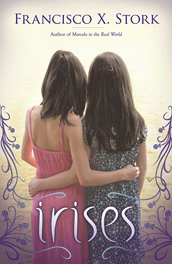
Irises

Irises by Francisco X. Stork, 2012
Arthur A. Levine/Scholastic

Rating: 3/5

IQ "Mary smiled. She always smiled when people said living family. It meant that people didn't stop being family when they died; they just turned into your dead family" pg. 144

18 year old Kate wants to be a doctor, 16 year old Mary wants to be an artist. Both girls must put their dreams on hold when their strict father dies, leaving Kate as Mary's legal guardian since their mother is in a permanent vegetative state. Her father told Kate that family always comes first, even if that means Kate needs to hold off on Stanford. Further complicating the matter is that Simon, Kate's boyfriend, has asked her to marry him in order to provide for both her and Mary. Meanwhile Mary is drawn to Marcos, a boy with artistic talent but a violent past. The girls are struggling over the death of their father, accepting their different personalities but what may be the final wedge between them is the decision regarding their mother. They can no longer afford to pay the medical bills keeping her in her vegetative state but she is their mother....

 I love Francisco Stork's books. Long time readers of this blog know that, I adored Marcelo in the Real World and was quite fond of The Last Summer of the Death Warriors. Unfortunately I found Irises to be my last favorite Stork book thus far. Granted, this was bound to happen but the summary was so good that my hopes were quite high. All this being said, it was difficult for me to put my finger on why I did not like this book. It just didn't work for me. Part of the issue was that Stork raises juggles so many balls in the air, in a way that I did not find effective. I wish he had stuck to two or three issues (such as the issue of whether or not to pull the plug and how to cope with their new-found independence) and focused on really fleshing out the secondary characters (such as Simon and even Mary). I found the issue of life support inadequately explored, even though I had thought that was at the whole heart of the book. I did find it interesting that the girls (especially Mary since she was younger) did not go crazy or at least engage in more normal teenage acts that their father had previously forbidden. Of course most people don't immediately go party after the death of a parent, but I was surprised that very little mention was made about bigger temptations of Mary and Kate (such as going to the mall, an act their father did not allow).

 Both girls seem to be losing their way where their Christian faith is concerned and I felt that Mr. Stork did a good job of subtly addressing the questions that arise when one has a crisis of faith and whether or not you can return to your faith. I also found it really interesting that the author made the girls Protestant. This was a note of interest to me because the girls are Latino and I'm Latino, and I have grown up around mostly Catholic Latinos so I found this new world of Protestant Latinos quite intriguing (of course not all experiences are the same but the book gave me a basic idea). I thought the idea of marriage-as-an-escape was an issue well-explored, even if its a concept many people do not realize is prevalent. Kate was also a great multidimensional character as was the pastor, Andy Soto. I found their interweaving storyline to be the best in the book (it is mostly Kate's story) and very believable.

 Ultimately Irises left me indifferent, I certainly don't hate it but I did not love it or even enjoy the book all that much. However the writing is mostly strong, with a few secondary characters left underdeveloped. The book mostly suffers from having too many plots and setbacks occurring. Its strength lies in the simple, effective writing and the realistic dialogue. The issue of faith was portrayed in a respectful, non-preachy manner which made the book more compelling. What did everyone else think?

Disclosure: Mr. Stork kindly sent it to me (a whole year ago I'm ashamed to say). Thank you so very much!

Cover image from Francisco Stork's website

Thursday, September 1, 2011

Throwback Thursday: And Then Everything Unraveled

And Then Everything Unraveled by Jennifer Sturman 2009
Point/Scholastic

Rating: 3.5/5

IQ "My armor. You know. Self-protective camouflage. Everybody has armor. Even you, I bet, though I still haven't figured out what form yours takes." Quinn pg. 169

Sixteen year old Delia Truesdale's mother, T.K. has disappeared. T.K. was working on a project in Antarctica with an environmental group that she actively supported. Delia learns a few weeks later that the ship carrying her mother and the crew has vanished and they are all presumed dead. Delia refuses to believe it, especially since T.K. has a plan for everything and she's much "too organized to simply disappear" (back cover). Over Delia's objections she is sent to live with her boho aunt Charley (who has no experience raising kids) in New York City, her mother's other sister, Patience is uptight and in charge of Delia's schooling and finances. The move from Silicon Valley to NYC is a cultural shock. When the two aunts aren't battling over Delia, they are fighting over every little thing. All Delia wants is to find her mother and not fall in like with Quinn, the king of the Do-Nothings. It becomes clear to Delia that she is the only one who can do something about her mother's disappearance but the case quickly becomes much more intricate than she thought.

I'm not sure if it's an element of a mystery novel or not but I've decided that I'm really bothered when a character foreshadows something very dramatically (i. e. "I should have known..." or "How could I have been so stupid..." etc). These statements have really started to bug me and there are a few of those throughout the book. The ending was an annoying type of cliffhanger and yet as I type this review and reflect I've realized that I'm not in a hurry to read the sequel (which I own). I thought it was somewhat ironic that the ice queen Aunt Patience was a more well-rounded character to me than Aunt Charley. I found Charley to be the typical free-spirit, reluctant-to-play-mom-but-rises-to-the-occasion-beautifully aunt. Patience was more complex, in part because Delia doesn't spend much time with her so there's an air of mystery about her. Of course we have the genius best friend who is a whiz with technology and thus can crack anything. I really need to find a friend like that because they only seem to exist in books and movies.....And I have to admit I'm skeptical at the power a certain oil company yields so I was disappointed that I couldn't entirely believe the plot. The most ANNOYING part though is a *spoiler: highlight to read* that Delia finally told Quinn what was going on and not only does the author write the scene off camera (so to speak) but we don't get to read about his reaction afterward, we are just told to assume he accepts it. Ugh no!* End of spoiler

All that being said, I really liked the mystery element. It's not ridiculously dramatic (as in a teenager solving a murder or something) and while one particular villain was obvious, I was not expecting another villain (hinted at via psychic in what I thought was a clever twist). The mystery is rather complex and it's definitely original. Delia is a down-to-earth, mostly logical main character who neither wallows in self-pity nor is she overconfident about her looks. In short, she has good self esteem. I enjoyed reading about Delia's comparing and contrasting NYC to Silicon Valley having only spent four tourist-y days in NYC and never been to California. Plus as flat a character as Quinn was, he embodied typical boy in being so on and off so I definitely could relate to Delia's confusion. I did roll my eyes at the classic Romeo and Juliet scene performed in drama class of course in front of everyone.

And Then Everything Unraveled is an appealing read due to its mostly plausible mystery and the engaging voice of Delia. The setting of NYC is a vibrant one in this book as well and I liked how some of the seemingly-random occurrences were tied into the story. I have to admit I don't see why the author couldn't have made this one mystery story instead of making a sequel. I thought the book was moving slowly and knowing I had the sequel didn't appease me, it just bothered me that I knew the mystery wouldn't be wrapped up and the book would mostly be about the more mundane and the data-gathering. Most of the characters were typical, Quinn is nothing special, Aunt Charley is great fun but still typical (there was a time when she would be atypical but now that I'm a somewhat jaded reader....haha) and Thad is predictable although his motives are fuzzy. The mystery did keep me on my toes when Delia stopped thinking about Quinn. I will eventually read the sequel especially since I'm hoping Delia's half Indian side (her father died) will be explored.

Disclosure: Won (over a year ago I think which is super embarrassing) from Marjolein Book Blog and the author (autographed). Thank you both so much!

Monday, August 29, 2011

Male Monday: We Could Be Brothers

We Could Be Brothers by Derrick Barnes 2010
Scholastic Press

Rating: 1.5/5

IQ "I didn't care anymore if he thought I was tough enough or hard enough or cool enough. All I knew was that when it mattered most, I was friend enough. " pg. 145

Robeson Battlefield and Pacino Clapton come from two very different homes. Robeson (nicknamed Crease by Pacino because of his iron-pressed pants) lives in, as Pacino calls it "a nice chunk of the suburbs slammed right down in the middle of the hood" (pg. 25). Pacino lives in "the hood" and helps his mother pays the bills and watches over his younger siblings after school. Pacino and Robeson wouldn't have met if it weren't for Tariq, a kid who get them both in PSS (Post-School Suspension).

Short summary I know but the book the jacket describes must belong to some other book. And I can't write a more thorough summary because it would give too much away. First, based on the cover, I thought the book involve a variety of narrations from Pacino, Robeson and Tariq. It does not. First, Pacino acts all "hard" and then decides to be friends with Robeson. It happens completely out of the blue in my opinion. Robeson has zero personality, he preaches and preaches and preaches but he's believable because I definitely knew annoying know0it-all kids like him when I was in junior high. I'm not so sure the author intended to make him sound so insufferable though but like Pacino, I was irritated at how he always quoted his father's life lessons at random moments. Robeson's only flaw was that he wasn't a straight-A student which isn't that serious since he's not in high school yet anyway. Pacino's flaw might be that he uses the m-word or likes to fight but neither of those is detrimental or explored in a way to make the reader see why it's so bad.The most annoying aspect of this book was that fact that Robeson explained EVERYTHING in too much detail, the author explained things that a reader should be smart enough to gather based on the text. For example, "You're no guest. You come over so much now it's like you're one of my big-headed boys,' Dad responded to Pacino, calling him one of his sons in a roundabout way" (pg. 162). The author should have faith that the reader will be able to infer that the father is calling Pacino one of his sons based on what the father says, the extra text is unnecessary and it drives me crazy. The extra explanations continue throughout the duration of the book.

I HATED how Robeson talked about Rosilyn, the one girl in PSS with Pacino and Robeson. For a supposedly educated "brotha" he acted extremely ignorant. Again, I think if the author did this on purpose a worthwhile lesson could have been subtly taught but the issue of how Robeson treats Rosilyn is never addressed. Only how Pacino treats her which isn't entirely respectful but sometimes he acted a lot nicer than Robeson. At one point Robeson thinks to himself "[s]he looked like a lady today" (pg. 101) He's in EIGHTH GRADE. I may be naive but I'm fairly certain the guys in my eighth grade class did not care one bit if a girl looked like a lady. Then he goes on to insult her further by thinking that "[s]he had on a pretty silk blouse and some kind of gold necklace that she must have borrowed (pgs. 101-102, emphasis mine). You know what people say about assumptions....why would he even think that she borrowed the necklace? It was just rude and incredibly ignorant and made me mad to no end. True I was already annoyed by the talking down to readers but the Rosilyn incidents didn't help. Furthermore the continuous use of "brotha" was ridiculous. Back in the day I think teenagers used that expression a lot more but I have NEVER heard a teenage Black guy my age say "brotha." Maybe "wassup bro" but usually it's "dude" or "man" or even "n-" or something of that ilk. My father and his friends would be more inclined to say "brotha" and they usually say it as a joke. Therefore I found it hard to believe that Crease and Pacino would walk around saying "brotha" instead of the n-word.

We Could Be Brothers was a book I was waiting on eagerly. I loved the author's first book, a YA novel that was authentic and managed to talk about the importance of teaching Black boys particular lessons in a humorous, subtle manner. Unfortunately this book does not deliver. I felt as though the author talked down to his readers, constantly explaining what was going on in a particular scene with unnecessary dialogue and explanations when the reader could easily understand the situation. The book is preachy and dull. I wish the main characters had included Tariq and that the author had further delved into the heads of all three boys. Instead they remain flat characters that the author uses to make certain points. Initially I was going to give this book a 2 but then I couldn't think of a single reason as to why I would recommend someone read it. The Making of Dr. Truelove was absolutely hysterical. I'm inclined to think that maybe the author should stick to funny YA novels or write nonfiction books about raising Black boys because THIS is just not working.

Disclosure: Received as a gift from Zetta Elliott. Thank you Zetta :)

Thursday, December 23, 2010

Throwback Thursday: The Stone Goddess

The Stone Goddess by Minfong Ho 2003 (First Person Fiction series)
Orchard Books Scholastic

Rating: 3.5/5

IQ "As flowers sacred to Buddhism we had always been taught that because the lotus had its roots in the mud, grew trough the murky water, and blossomed in the open air, each lotus was like the human spirit." Nakri pg. 4

Nakri Sokha and her family live peaceful lives in Phnom Penh, Cambodia. Nakri's mother teaches Nakri and her older sister, Teeda the beautiful classical dances of Cambodia and Teeda aspires to one day dance the highest role, the role of an aspara (celestial dancer). All that changes when the Khmer Rouge takes over Phonm Penh. Nakri and her family are forced to evacuate the city and eventually Nakri, her brother Boran and Teeda are taken away to a labor camp. Nakri despairs of ever seeing her family again, but Teeda keeps her hopes up. Once they are finally reunited with their family, they head to Thailand, and from there, America. But nothing is the same after the cruel Communist rule of the Khmer Rouge and Nakri can't forget about all that she saw and endured.

This might not be as big a deal to anyone else, but I wanted more dance details :) I wanted to learn more about celestial dancers, the steps. the costumes, the music, the stories. I also would have preferred to read the story from an older teen's view. Nakri (who is twelve) doesn't know about much that is going on and since I didn't either, I wanted more details about how the Khmer Rouge came to power. I knew they were cruel obviously and I remember the name of the leader (Pol Pot) but I wanted to understand why they were allowed to run rampant for so many years, was there opposition to their rule? Finally, I had a problem with the narrative of the story. It starts off rather quickly which is fine. Then, Nakri heads off to the labor camp and apparently three years went by. There was no indication that time was passing at all, and I suppose that's ok because being in a labor camp is probably the same thing everyday: backbreaking work and cruel supervisors, but I didn't think I got a chance to really see how Nakri and Teeda coped with their situation. Then time flies by in the Thailand at a refugee camp and ends in America. The America scenes are towards the end and the book ended rather too abruptly for my taste.

My favorite thing about this book were the strong and vivid family relationships. Nakri and her sister, Teeda have such a close bond and it's a great thing to read about. It's almost unreal because none of the siblings argue with each other. I didn't know that was possible! Teeda tells Nakri stories and watches over her as does her older brother, Boran. Their youngest brother, Yan, doesn't make many appearances in the story but he gets along well with everyone else. Nakri's parents are genuine, they aren't overly mean or cold and they aren't soft and forgiving either. They are a mixture of both, like most parents. As much as I complained about the narrative from a child's perspective, it did (over)simplify things and I still got the basic idea of what was going on. There was plenty of details about everyday life in Cambodia, the people, the buildings, the food. I felt immersed in the culture.

The Stone Goddess is a horrifying read in that the cruelty of the Khmer Rouge is aggravating and yet sadly, believable. The writing and characters are rather simple and the situation seems to be too simple but it's still informative. How many students today know anything about Cambodia (I'm not even sure I could point it out on a map. I vaguely know the area)? I do wish that the story hadn't been so simple and that the family wasn't so nice. At the same time, the cozy family relationship was refreshing and there was enough drama and hardship to keep me turning the pages. The final scene, while abrupt is absolutely beautiful.

Disclosure: From the library

Throwback Thursday is hosted by Take Me Away

Monday, October 4, 2010

Male Monday: The Dreamer

The Dreamer by Pam Munoz Ryan, illustrated by Peter Sis 2010
Scholastic

Rating: 4.5/5

IQ "Without them there, Neftali lingered. He found a stick and defiantly wrote giant words in the damp sand. Neftali dropped the stick, feeling a peculiar sense of ownership. He spread his arms and listened to the ocean's thunderous applause. He bowed. The ocean was now his audience." Neftali, pg. 234


The Dreamer is a creative look at the early years of Neftali Reyes, aka, Pablo Neruda. Neftali is often sick so he misses school. While he stays at home, he likes to daydream while looking outside his window. His father wants him to become stronger, so he pushes Neftali to go outside. Neftali is happy to oblige because he loves to explore, but his father is not pleased when Neftali comes back with seashells and other interesting things he finds lying around outside (he has quite a collection). His father is harsh (he hates to see Neftali read or write) and Neftali has no friends at school. His stepmother is a doormat and his older brother (his protector) will soon be leaving him. All Neftali has is the lush Chilean countryside, his books and imagination.

Is it a coincidence that in my Spanish class we had to read and translate one of Pablo Neruda's most famous poems, Tonight I Can Write (or as it's known in Spanish, Puedo Escribir) right after I finished reading this book? I hope to one day be fluent enough in Spanish so that I can read his poetry in its original, beautiful form. I have to admit, my biggest qualm with this book was the magical realism. It was a nice touch to be sure, but I was expecting more biography. I came away from this book thinking that I really didn't know that much about Pablo Neruda, which was disappointing since I didn't know much to begin with (although I did learn about why Neftali Reyes changed his name to Pablo Neruda). Or at least, not as much as I wanted to know. Plus I'm not sure what's fact and what's fiction. This was unfair on my part because I expected something different from this book, but nevertheless, my expectations influenced my feelings on the book.

That being said, the magical realism allows for the author and illustrator to be truly creative. In The Dreamer, Neftali daydreams that words lift off pages and out of drawers (he keeps a drawer filled with his favorite words) and the drawings and poetry throughout this book seem to do the same. Perhaps the best way to describe the writing is by using the author's own words, "The rhythm of his rain-soaked childhood became a sequence of words. His memories of the understory of the great forest burst into lyrical phrases, as resinous as the sap of a pine cone, as crisp as the shell of a beetle. Sentences grew long, then pulled up short, taking on the tempo of the waves upon the shore, or swayed gently, like the plaintive song of a lone harmonica." (pg. 344). She is describing the work of Pablo Neruda, but this could just as easily be referring to her writing in this book. The drawings help the reader to better visualize what Neftali sees in his daydreams and they are extremely well done. They are whimsical in nature and make this book one that you will want to keep on your bookshelf, if only to look at the 'pretty' pictures (of course the writing is exquisite as well).

The Dreamer is not going to reflect much on Pablo Neruda's adulthood. It does talk about his childhood and his demanding father along with his complacent stepmother. However I wasn't stasifeid with the information shared about his family. I wanted more! What happened to his mother? Why was his father such a jerk? Granted Neftali is a young boy for most of the book so he may not know the answers to the questions that I ask (and I could and will look them up). The setting of Chile comes alive through both the words and the drawings. In fact, I would say I learned more about the geography of Chile than I did about Pablo Neruda. Which may not be such a bad thing. Not only did the book extensively cover Chile's landscapes and animals, it also discussed the issue of indigenous people being forced off their homeland. In Chile, the Mapuche people had been there for hundreds of years and yet Chileans were trying to kick them off their land and create more businesses and homes. They refused to work WITH the Mapuche merely because not all the Mapuche spoke Spanish or knew how to read and write. The issue of native people being forced to leave by foreigners is (sadly) nothing new, but it was new to me in that it occurred in Chile and I found it quite enlightening to read about. This book is filled with memorable lines and I want to share one more with you "I will start by writing more stories, stories that might make people whisper behind closed doors. Did you know that many whispers can make a very loud noise?" (pg. 307). These words are said by Neftali's uncle, Orlando, but I think it's safe to say, Pablo Neruda's poetry also started whispers that created a loud noise (after all the government did invade his home). Furthermore, there are whispers that The Dreamer is a strong Newbery contender. My guess would be a Latina has never won the Newbery, but I can't say for sure. The only other rumored Newbery contender I've read is One Crazy Summer by Rita Williams Garcia and I would be happy with either one winning.

Disclosure: Received from Lyn. Mil gracias Lyn!

Monday, July 12, 2010

Male Monday: Harlem Summer

Harlem Summer by Walter Dean Myers 2007
Scholastic

Rating: 3.5/5

IQ "Mark, you are a young black man. Sometimes, living here in Harlem, we walk on the sunny side of the street and sometimes we walk on the shady side. I know that because I've been black a whole lot longer than you. Anything you've seen-I've lived. But I also know that you got to be careful on both sides of the street." Daddy pg. 130


It's summer in Harlem in the year 1925. It's hot and exciting. Mark Purvis is sixteen and looking forward to his summer, as long as he doesn't have to work at his uncle's funeral parlor. Mark ends up getting a job working for The Crisis where he meets the "New Negro". He could care less about being a "New Negro", he doesn't even know what that means. He does know that he wants to play his saxophone with Fats Waller. Before Fats hears him play, he offers Mark a chance to earn some quick cash. Except it goes horribly wrong and now gangsters are after Mark and his friends. They want their money or they want Mark and co. dead. It's sure to be an amazing summer.

By now I think most of you know that the Harlem Renaissance is my favorite time period in American history so I was really excited to read this novel. I didn't really have any expectations of the story, I just wanted to get a better idea of what Harlem was like during the 1920s and on that front this book did not disappoint. I could feel the heat rising off the sidewalk and imagine all the nightclubs and aspiring musicians lining up to perform in the clubs. One of the most fascinating things about this book (for me anyway) was the characterization of DuBois. Many of you may know that there was a huge rift between W.E.B. DuBois and Booker T. Washington. Basically Washington wanted Black Americans to focus on being teachers, farmers, etc. He didn't really have a problem with segregation either. DuBois wanted Black Americans to enter politics, business and higher fields of education. He abhorred segregation. Both Washington and DuBois believed in education, they just wanted to sue the power of education differently. Anyway, I'm firmly on DuBois' side but this book portrays him in a mostly unflattering light. Everyone was terrified of him and he's seen as demanding and cold. I thought it was very interesting but I still love him for his ideas and starting The Crisis (one of the main Black newspapers of the time).

The story is funny, Mark tends to exaggerate and he doesn't always realize how grave a situation he's in. I did find it annoying how his luck always seemed to be good. Everything worked out for him, but the book could have been really sad if that wasn't the case. However I didn't mind it too much since I'm not in the mood for sad reads right now. Each chapter has a engaging title that makes you want to keep reading to figure out what it means. My personal favorite was "I Am Taken To Jail Like A Common Thug, Given The Third Degree, But Am Saved By My Reputation As An International Gangster, Bad Man, And The New Breed of Criminal." (pg. 134) The characters aren't as well developed as I would have liked. It very much seems to be written for young readers as an introduction to Harlem during the '20s, Mark meets some of the most famous people of the time. He also visits famous places, reads famous newspaper, etc. I just wish we learned more about the characters, instead they are simply commented upon as they pass by.

Harlem Summer is a lively story about a little known period of American history, the Harlem Renaissance. The fact that it reads like an introduction to the Harlem Renaissance both helps and hurts it. Older readers may roll their eyes at Mark's convenient connections to everyone famous in Harlem, but it's a great way to whet readers appetite for more. I wish the novel was longer so I could have learned more about Queenie (a Black female gangsta), Countee Cullen, Dubois, etc. I also wanted to know more about mark's family, his father is hilarious but his brother Matt remains a shadowy figure. I did like that Mark's mother and father both played a prominent (often amusing) role in his life. Prepare to visit Harlem and meet a character who has the best luck and gets in the wackiest scrapes.

Disclosure: My family bought it with their own money.

*I will be out of town until Saturday July 17. I will have limited computer access so I can reply to your emails and comments. All my posts are scheduled. Have a great week :)

Saturday, May 22, 2010

Off Color: Absolutely Maybe

Absolutely Maybe by Lisa Yee 2009
Arthur A. Levine/Scholastic

Rating: 4/5

IQ "I don't care if you're Thai, Chinese, French or from Mars. You'll still be mine, all mine, no matter what. God, I love you, Thammasat Tantipinichwong Schneider!" Maybe pg. 272

Maybelline Mary Katherine Mary Ann Chestnut (she was named after mascara and various Miss Americas, just call her Maybe) has had enough. Her mother, Chessamay (Chessy) Chestnut Abajian Wing Marshall Wing Sincalir Alvarez is getting married again, for the seventh time. The men Chessy marries are almost always jerks. However, the latest husband is a particular sleazeball. Once again, Chessy chooses a man over Maybe so Maybe decides to go find her father in L.A. Maybe has never met her father, she doesn't even know his name since he never got married her mother and her mother refuses to talk about him. Maybe's best friends Ted and Hollywood (who is going to USC) head to L.A. with her, where they meet some interesting characters. They see the best and the worst of L.A. from movie stars to taco trucks to the homeless.

This is probably one of my favorite friendship novels of all time. Maybe, Hollywood and Ted (Thammasat Tantipinichwong Schneider) are fantastic. as seen in the IQ above, they are deeply loyal to each other and completely accepting. I mean, how many of your friends would head off on a road trip to California with you? (well Hollywood was already going since he got in to USC but Ted had no reason to go). Ted is organized, smart, a know it all, dynamic and short. He gets terrible grades and he is very in-your-face, in fact he can be quite arrogant, but he is so so lovable! Hollywood (Daniel Jones, one of the few main characters who doesn't have an extremely long name), is quiet, a white boy with an Afro and an aspiring filmmaker. These characters have layers and you will fall in love with them as you learn more and more about them. After much thought I have come to the conclusion that Ted is my favorite character. He's from Thailand and was adopted, but his white parents really want him to connect with his culture, so they take him to Thai Cultural Club meetings so that he can learn about the language, food and traditions. They cook Thai food fro him and he calls them Maah and Paww (Thai for mother and father). The relationship between Ted and his parents is absolutely adorable and Ted deserves his own novel. I love Little Willow's title idea of Definitely Ted (which we discussed during the readergirlz chat with Lisa Yee that I participated in). Maybe is a rebel, a fighter and an amazing individual. She dyes her hair various different colors (pink, blue, etc.) and she wears baggy clothes, disregarding fashion. Her mother runs a charm school and is appalled by Maybe's lack of fashion sense and her disregard for proper makeup technique. Sammy was the most amazing father-like figure, Willow made me laugh (unintentionally), Ridgeway was fresh and random and even the reclusive Miss Gloria De Tour (a famous actress in the movie whose career is just about over, she takes a strong liking to Ted) added something to the story.

At first, every time I saw the word "Maybe", I thought the characters were just always very indecisive, it took me a little while to remember and get used to the fact that when the characters said "Maybe" they were talking to the character, not trying to make up their minds! I think the outcome of Maybe's search for her father was fairly predictable, but that's OK because it's realistic and not really what the novel is about anyway. Maybe touches people wherever she goes, pushing them to follow their dreams, but sometimes she neglects to inspire and help herself. Sometimes she seemed to just give up, which was understandable but other times I wondered why she was so unresisting (like when her guy friends basically refused to help her anymore and she ended up homeless. Or when they made her sleep on the floor). The novel is a bit unrealistic (especially Ted's job), but that adds to the appeal of the novel. Maybe ends up working at a taco truck and the author does a great job of making you salivate over her descriptions of various types of tacos. There is a lack of taco trucks in my neighborhood, but I will be taking a trip to the city in order to find one :)

Absolutely Maybe is a charming story with original characters that make for a funny, fresh read. Be prepared to have some tacos on hand to eat while you read this book. This book is a great summer read, it takes place over the summer and it's so much fun with the outrageous characters and crazy situations. I did get frustrated with Maybe at times, but I was invested in her well being and happiness throughout the whole book. She's a heroine you will find yourself cheering for and you may even be inspired to dye your hair (hmm any suggestions for a hair color for someone with black hair??) ;)

Disclosure: Won from Lizzy at Cornucopia of Reviews. Thanks Lizzy!

Check out the cover story of Absolutely Maybe to see the different covers considered (I wish they had used the last one with Ted and Maybe, Ted is so cute!)

Off color reviews are reviews of books that are by authors of color but not about POC and/or the main character is white, but there are important secondary characters of color.

Monday, February 8, 2010

Male Monday: The Last Summer of the Death Warriors

The Last Summer of the Death Warriors by Francisco X. Stork ARC
Scholastic

Release Date: March 1, 2010

Rating: 5/5!!!!

IQ "He [D.Q.] wrote that the reason God created the world was because He was lonely. He wanted others to love Him, but He didn't want to force them into it. So in order to make sure that there were souls chose to love Him, he made the world such that He was kind of hidden. Then he put people on earth and gave them some clues about how to find Him. That way, some could choose to look for Him and some could ignore Him. And He could be sure that those who persisted in looking for Him truly loved Him." Helen pg. 114

*Deep breath* I'm trying to keep from totally raving about this book because that review would not be particularly helpful. Warning: This post may have random moments of gushing. First of all, this books is by the same author of Marcelo in the Real World. I love The Last Summer of the Death Warriors but I LOVE Marcelo in the Real World more (but I love them both let's be clear, Marcelo is just my first favorite). Anyway, The Last Summer of the Death Warriors is about Pancho and D.Q. Pancho's life is filled with death, his mother died when he was five, his father died in a work-related accident and his sister was murdered. Pancho has to go live at St. Anthony's (an orphanage), where he meets D.Q. who is dying of cancer. They are the same age (17), but view life vastly different but both in a very mature way. All Pancho wants his revenge, he wants to find his sister's murderer and kill him (or her) since the police refuse to do anything (citing a lack of evidence indicating foul play). D.Q. is writing the Death Warrior Manifesto, a guide for him on how to live life to the fullest, full of love and faith. He has very little time left. Finally, D.Q. wants to profess his love for Marisol to her, but Pancho is falling in love with her as well.

I don't want to compare Mr. Stork's two books, but I will say this, the main characters are WAY different. Not just for the obvious of Pancho not having Asperger's. Marcelo is brilliant and innocent, Pancho is smart in his own way and he has lost his innocence. Pancho has to repeat his junior year (who can blame him with all the family tragedy that has occurred) of high school and he doesn't always understand the conversations D.Q. has or the words he uses (along with other people in his life). He doesn't speak Spanish either, his father wanted his kids to speak English since they grew up in America. Pancho can read people really well though and that's a valuable skill. The romance was different too, because it was an interesting love triangle. You want Marisol (a teen who volunteers at Casa Eperanza, an outpatient home) to choose D.Q. AND Pancho, I hated that she had to choose because I grew to love both boys and see their good and bad qualities. Also, Pancho describes Marisol as "nothing to write home about" but she has an inner beauty and she's a wonderful person and I really felt for her and her struggle over which guy to choose. D.Q.'s relationship with his mother, Helen is messed up, its's been seen before but it's different too, because Helen really feels bad and wants to help D.Q. as much as she can, she just doesn't realize that her way might not be the best way.

Another thing I really like about Mr. Stork's work is that he writes about people with mental disabilities, a group of people that is all too often ignored in YA literature. Pancho's sister, Rosa has the mind of a ten year old, but she's twenty. She knows how to read, write and do basic arithmetic and she has a job, but she doesn't fully understand the ways of the world. I was so touched by the relationship between Pancho and Rosa because it was so genuine, he loved her, but he was also ashamed of her and how he treated her when he felt ashamed. Pancho would get angry at his sister over things she couldn't control or what she didn't/couldn't understand. He feels remorse for all this and it's part of the reason as to why he must find his sister's murderer and impart his own form of justice, he feels that he needs to show his sister how much he loves her. Her story broke my heart, it is told through her diary entries and Pancho's own memories, good and bad.

This book is memorable and utterly quotable, especially the Death Warrior Manifesto. D.Q. has immense faith, but it's not particularly religious (i.e. Jesus is not mentioned a lot, God is but mostly it's just about having faith in a higher being and a better life ahead of us). One of my favorite parts of the Death Warrior Manifesto is the no whining rule because it re-defines whining in a way I never really thought about "You know what whining is? Whining is that little voice inside of us that always complains about whatever happens. The voice doesn't have to be heard by others for it to be whining." D.Q. pg. 39 I've never considered that internal complaining is whining, I intend on trying to incorporate all parts of the Death Warrior Manifesto (living a life of gratitude and love) in my own life because they are valuable lessons and can enrich all lives. This story never becomes too depressing or cliche in the whole angry-teen-who-only-grunts or brave-boy-dying of cancer. I don't mean this in an offensive way, but it was nice to see a more original depiction of someone suffering from cancer, D.Q. is a great character and very brave, but he's also human, a saint with flaws. And Mr. Stork is one of the few authors that can make you feel slightly bad for a murderer.

The ending was unexpected. I was expecting something a little more dramatic, but I liked the ending. In retrospect, I think it fit well with the book. I was on edge the whole time, wondering if Pancho would follow through with tracking down his sister's murderer (D.Q. and Marisol are desperately working to change his mind), if D.Q. would be healed, and who Marisol would choose. Francisco Stork is an amazing author, his work will never cease to amaze me and I am in awe of his talent for bringing genuine, lovably flawed characters to life and writing stories that cause your heart to break and mend all on its own. The Last Summer of the Death Warriors is a reaffirmation of what is important in life and also provides a fresh perspective on the importance of never taking each day for granted. Alright, this review is long enough. But this is a MUST READ and is another book you will want to revisit. High school and up.

Disclosure: Received from Lyn and it's autographed!!!!! I was so ecstatic when I opened the mail and found this, I walked around with a grin on my face for the rest of the day. I just wish I hadn't waited so long to read this book. And no, I did not give this book a good review because it was autographed because truest me, I've reviewed some decent/just ok books that have been autographed (I just choose not to mention that).