Showing posts with label contemporary. Show all posts

Monday, June 10, 2013

Girl Meets Boy

Girl Meets Boy: Because There Are Two Sides to Every Story; edited by Kelly Milner Halls, featuring stories by Chris Crutcher, Kelly Milner Halls, Jospeh Bruchac, Cynthia Leitich Smith, James Howe, Ellen Wittlinger, Rita Williams-Garcoa. Terry Trueman, Terry Davis, Rebecca Fjelland Davis, Sara Ryan & Randy Powell (ARC version) 2012
Chronicle Books

Rating: 2.5/5

IQ "I know this shouldn't be anything, shouldn't matter, but for some reason it does matter to me; Raffina is black, and I'm white. Of course, she's not really black any more than I'm really white. She's kind of dark brown, no, kind of medium brownish. I'm definitely sort of beige or something, light beige, tinted pink or red depending on how much time I spend in the sun (I don't tan, I just burn). Maybe a better way to put this is that Raffina's ancestors came from Africa, and my ancestors came from....I don't know....not Africa. Someplace like England or Germany or Canada or something." Sean + Raffina, Sean pg. 117 (Trueman)

Twelve authors, 6 stories, straight and gay relationships. One author tells the story from the guy's point of view, the other tells the story from the girl's point of view. I picked the quote I did because it made me laugh in its simplicity and truth.

 The back of the book describes this as a "collection of he said/she said stories" but I was disappointed in that regard. Instead these are stories about the differences between guys and girls ways of thinking but I was expecting each story to be about one situation/conflict told from the perspective of the guy and girl. Those sort of stories would have been more appealing in my opinion. The stories also did not seem to mesh well with the other half of the story, let alone the stories included in the overall collection and since they ended up not all being about romantic relationships I found it a bit confusing. I know short stories have to be short but these seemed to be too quick, the main character was developed but the other characters introduced sort of floundered. Furthermore found most of the characters to be rather forgettable and I was not particularly invested in the outcome of the so-called relationship. I also never thought I would say this but..the stories needed more romance. They just seemed bland.

 I did really enjoy the story 'Love or Something Like It' (its Chris Crutcher, who I love) and its complementary story, 'Some Things Never Change' (Halls) because they really took stereotypes and turned them on its head with the jock and the 'slut'. I felt Cynthia Leitich Smith and Joseph Bruchac did a good job of actually linking up their stories in  'Falling Down to see the Moon' (Bruchac) and 'Mooning Over Broken Stars' (Smith). And 'Launchpad to Neptune' (Sara Ryan & Randy Powell) is absolutely fascinating, it actually had a plot twist that I did not see coming and had well developed characters besides the main ones. There are points in each story that are relatable and while each story has one major issue and its all rather straightforward, they are stories that need to be told especially for those who need to get over their own prejudices. Books like these might help gently prod them to rethink their antipathy to dating someone outside their race, or to disapprove of those who are gay or lesbian or to judge people based on the number of people they may or may not have slept with.

Girl Meets Boy contains a collection of short and sweet stories from some of the best talents in the YA world and while I think these stories might have been more memorable if they were longer/a book of their own, better to have a little of the story than none at all. The stories can be heavy-handed at times and the supporting characters fell flat (and the cover's weird) but they are interesting. I also loved the last bit at the end where each of the authors (except Rita Williams Garcia, who I really wanted to hear from) shared their inspiration for their respective story. This book is a quick read that will pass the time but it most likely won't stay with you, read it at the beach or in a park.

Disclosure: This is embarrassing but I don't remember.....I think I got it from the publisher. Whoever it was, thank you!

Tuesday, June 4, 2013

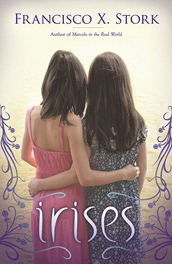
Irises

Irises by Francisco X. Stork, 2012
Arthur A. Levine/Scholastic

Rating: 3/5

IQ "Mary smiled. She always smiled when people said living family. It meant that people didn't stop being family when they died; they just turned into your dead family" pg. 144

18 year old Kate wants to be a doctor, 16 year old Mary wants to be an artist. Both girls must put their dreams on hold when their strict father dies, leaving Kate as Mary's legal guardian since their mother is in a permanent vegetative state. Her father told Kate that family always comes first, even if that means Kate needs to hold off on Stanford. Further complicating the matter is that Simon, Kate's boyfriend, has asked her to marry him in order to provide for both her and Mary. Meanwhile Mary is drawn to Marcos, a boy with artistic talent but a violent past. The girls are struggling over the death of their father, accepting their different personalities but what may be the final wedge between them is the decision regarding their mother. They can no longer afford to pay the medical bills keeping her in her vegetative state but she is their mother....

 I love Francisco Stork's books. Long time readers of this blog know that, I adored Marcelo in the Real World and was quite fond of The Last Summer of the Death Warriors. Unfortunately I found Irises to be my last favorite Stork book thus far. Granted, this was bound to happen but the summary was so good that my hopes were quite high. All this being said, it was difficult for me to put my finger on why I did not like this book. It just didn't work for me. Part of the issue was that Stork raises juggles so many balls in the air, in a way that I did not find effective. I wish he had stuck to two or three issues (such as the issue of whether or not to pull the plug and how to cope with their new-found independence) and focused on really fleshing out the secondary characters (such as Simon and even Mary). I found the issue of life support inadequately explored, even though I had thought that was at the whole heart of the book. I did find it interesting that the girls (especially Mary since she was younger) did not go crazy or at least engage in more normal teenage acts that their father had previously forbidden. Of course most people don't immediately go party after the death of a parent, but I was surprised that very little mention was made about bigger temptations of Mary and Kate (such as going to the mall, an act their father did not allow).

 Both girls seem to be losing their way where their Christian faith is concerned and I felt that Mr. Stork did a good job of subtly addressing the questions that arise when one has a crisis of faith and whether or not you can return to your faith. I also found it really interesting that the author made the girls Protestant. This was a note of interest to me because the girls are Latino and I'm Latino, and I have grown up around mostly Catholic Latinos so I found this new world of Protestant Latinos quite intriguing (of course not all experiences are the same but the book gave me a basic idea). I thought the idea of marriage-as-an-escape was an issue well-explored, even if its a concept many people do not realize is prevalent. Kate was also a great multidimensional character as was the pastor, Andy Soto. I found their interweaving storyline to be the best in the book (it is mostly Kate's story) and very believable.

 Ultimately Irises left me indifferent, I certainly don't hate it but I did not love it or even enjoy the book all that much. However the writing is mostly strong, with a few secondary characters left underdeveloped. The book mostly suffers from having too many plots and setbacks occurring. Its strength lies in the simple, effective writing and the realistic dialogue. The issue of faith was portrayed in a respectful, non-preachy manner which made the book more compelling. What did everyone else think?

Disclosure: Mr. Stork kindly sent it to me (a whole year ago I'm ashamed to say). Thank you so very much!

Cover image from Francisco Stork's website

Friday, January 11, 2013

Chain Reaction

Chain Reaction by Simone Elkeles 2011 (Perfect Chemistry trilogy #3)
Walker & Company/Bloomsbury Publishing

Rating: 2/5

IQ "If I touch him, I could lose my nerve and let him explain away" Nikki, pg. 225

This is the final book in the Perfect Chemistryy trilogy and my review is spoiler-free (not just for this book but also for the previous 2 books in the series). Luis is the youngest of the 3 Fuentes brothers and unlike Alex and Carlos he has lived a relatively gang-free life. Until he moves back to Fairfield, Illinois the suburb rife with Latino Blood gang members who want him to join and be a leader like his brother Alex used to be. Nikki Cruz is the girl who has captivated Luis, mostly because she won't talk to him or allow him to get close to her. She's suspicious of his Latino Blood associations, she refuses to date LB gang members. Luis doesn't know if he wants to join the LB or no and Nikki doesn't know what will happen if she allows Luis to get close to her

 I picked the quote I did not because its majorly inspiring but because I think it captures a key moment in relationships, when you know that the person you're with messed up but that you will forgive them as soon as they 'say the right things' and touch you or hold you a certain way. When really that person needs to forget about 'the right words' and be honest.

 Anyway, I love this series and this is the book I was most looking forward to it but it doesn't compare to the first book. Or the second. Its my least favorite in the trilogy and there are a lot of elements about it that I really didn't like. I hated the ending. Not the epilogue, the LB violent ending (and no I didn't not like it because of the violence but because of who ended the violence). I also hated the family revelation. I thought it was a cheap way of shocking the reader and took away some of the appeal of the series. Granted the brothers handled it sweetly but still, it was a completely unnecessary family surprise. Also there wasn't much time spent with the beginning stages of Nikki & Luis' relationship. I totally understand lust-at-first-sight but it didn't stay that way and I wish the author had shown us how they grew to be so close.

 I did appreciate the fact that this book is so much different from its predecessors, in ways both good and bad. On the positive end, it was nice to see the girl portrayed realistically as always but also fairly un-Saintlike. The book did maintain its steamy, well-written romance scenes for teens, which are its strong suit. Along with the well-written characters ranging from Nikki & Luis to even minor characters such as Marco, Officer Cesar Reyes and the strong plot and setting of the story. Both Nikki & Luis are extremely headstrong and sometimes this stubbornness causes them to make foolish, prideful decisions. And then they have to deal with the fallout. It does all clean up tidily in the end, but its process and watching the characters try to pick themselves back up and make up for their poor decisions is rewarding and realistic and always refreshing to see.

Chain Reaction had almost all the right elements of being a good story but ultimately for me, two big plot twists ruined the rest of the book. While Chain Reaction bordered on the ridiculous at certain points, I was glad to read about the  youngest Fuentes brother and the people in his life, including the fiery-but-not-in-a-stereotypical-way Nikki. I loved that Nikki felt out of place amongst Mexicans even though she's Mexican American, she expressed feelings I definitely emphasized with and recognized. I would still highly recommend this series, the books are fun, hot, a great representation of teenage life (especially in Chicagoland suburbs) and there's never a dull moment.

Disclosure: Received from Lyn. Thank you so much!

Thursday, January 5, 2012

Throwback Thursday: The Ruby Notebook

The Ruby Notebook by Laura Resau 2010
Delacorte Press/Random House

Rating: 5/5

IQ (Zeeta thinking about the Castle of If aka Chateau d’If, located on a small island about a mile away from Marseille) “I wonder about true love, if that’s what J.C. had for my mother, even after one night. I wonder about Vincent and Madame Chevalier, and what their lives would have been like if they’d admitted their love years ago. I wonder about eternal life, if it would get boring, if you’d get sick of yourself and your thoughts and the world…or if things would seem new and different every day. I wonder if living forever would be terribly sad, always loving people, then leaving them behind. I wonder how you’d survive so many losses and still be able to love.” Pg. 233

Zeeta and her mother live in a different country every year, France is 16-year old Zeeta’s 16th country. Previously they lived in Ecuador which is where the first book in this trilogy, The Indigo Notebook is set. Zeeta’s mother loves living near water because she believes it calms her and can have healing powers so they settle in Aix-en-Provence, a city full of fountains, charm and mystery. Zetta soon befriends some traveling street performers and even develops a crush on one, Jean Claude. Unfortunately (or fortunately) Zetta’s boyfriend Wendell will be living in Aix-en-Provence for a summer art program, Zetta is torn over how she feels about Wendell and Jean Claude. She is also troubled by the mysteries anonymous notes and gifts she has been receiving, she calls this admirer her fantome (ghost). Wendell agrees to help her find out who her fantome is and to find a mysterious underground spring whose water is rumored to bring immortality. Zeeta’s help is enlisted by a local antiques dealer, Vincent and his reclusive artist friend, Madame Chevalier.

I’m still puzzled by Rumi quotes but I’ve just accepted that I will never understand him or Zeeta's mother's random use of them, but at least Zeeta doesn't get it either. This book was as close to utter perfection as a book can get. I freely admit that I’m biased towards books where the main character is completely immersed in another country. *shrugs* My previous complaint was that the author didn’t throw in enough Spanish/Quichua phrases but she obliges me here. I LOVE that this book not only features common French words and phrases but also French slang. It truly makes these books stand out because the reader is as close to immersion as possible without visiting or having the book be entirely in French. I’ve been on a French kick lately (reading this book, Anna and the French Kiss, watching Midnight in Paris-FABULOUS movie, and soon to read Paris Noire and This Side of the Sky) and I adore the culture, I desperately want to visit. I enjoyed this brief exchange about the French language when Zetta meets Jean Claude for the first time, “’Enchante, Zeeta.’ He says formally, shaking my hand. Enchanted to meet you. Not pleased. Not glad. Not happy. Enchanted. Magic seeps into even the most mundane interactions in this language.” (pg. 31), no wonder French is known as the language of love! Once again the setting comes alive in Laura Resau’s more-than-capable hands. We can see the street performers doing backflips and passing around a hat for coins, the quiet mime in the town’s square, envision the old houses with private houses and commiserate with Zeeta early in the book as she heads to the only Internet café in town to email and call Wendell. The cast of characters are lively, almost every facet of their being explored from the isolated Madame Chevalier to the mime Torture (French for turtle. Pronounced tor-TEW) to the nomadic members of the theater group Illusion (Jean Claude, Amadine, etc).

I could relate to Zeeta’s fear that she did not know how to be in a long-term relationship because her mother has ever been one. Not that I am in that same situation but Zeeta expresses her confused feelings on romance so well that it’s easy to sympathize with her because it's a frustrating situation. It’s easy to see why she is attracted to Wendell and Jean Claude, they both have attractive qualities. Instead of chasing Wendell’s birth parents as in the first book, here Zeeta is trying to get a better idea of her father because she suspects he might be her fantôme, even if he’s not she’s determined to make Layla remember any sort of clue. I can’t imagine having absolutely no idea who may father was or no way of tracking him down and having a mother who is utterly unconcerned. It’s easy to get caught up in Zeeta’s fantasy about her father but the actual scenario isn’t all that unrealistic. The story turns into a mystery and then takes a delightful turn into the magical involving Celtic lore and warriors and fountains. There’s definitely a quality of magical realism in this story and it flows smoothly with the narrative. I was pleasantly surprised by the Celtic traditions woven into the story but it was fascinating to read about because I was not familiar with the Celtic influence in France.

The Ruby Notebook has a whimsical quality but there’s more complexity to the story than that word allows. It’s a captivating read set in a captivating place, Aix-en-Provence. I really liked that Wendell and Zeeta didn’t do a cliché we-are-so-in-love-in-France type thing, instead their relationship is rocky. They both had some unrealistic expectations of a long-distance relationship and they have to work out the kinks or decide to break up. Not an easy decision but one that is explored realistically. The mystery unravels slowly and it’s truly difficult to figure out who the fantôme is, I did not see it coming. These stories could easily be adapted into films, they read like a screen-play (not that I’ve ever read one). Again, it is not necessary to read the first book in the Notebooks series but I highly recommend you do. You will finish this book feeling utterly enchanted with the setting, characters and author. Do not read these books hoping to be cured of wanderlust, I now have an insatiable desire to travel.

Disclosure: From the library

Tuesday, November 29, 2011

Under the Mesquite

Under the Mesquite by Guadalupe Garcia McCall 2011
Lee & Low Books

Rating: 4/5

IQ "I know he wouldn't purposely/hurt me; he's just venting/his frustrations,/So when I feel his anger/blowing my way,/I hold my breath and try to see through it. /But then the smoke burns my eyes/till they start to water,/and I know it's time to move-/find a clear spot/away from the smoldering coals." "What's Gone" Lupita pg. 111

Lupita is the oldest of eight siblings and so she is a huge help to her mother. Her mother tries to hide her cancer diagnosis from her children but Lupita discovers the truth and she is terrified by the very real possibility that she could lose her mother, the thread that holds their large family together. Lupita must take charge as head of the family while her father works and drives her mother to various treatment facilities, but her siblings won't cooperate with her and her class load is hardly manageable. If Lupita falls apart she fears the family will fall apart and she cannot allow that to happen.

Lupita's friends were bizarre. They jarred me so much that I couldn't get them out of my head even after they disappeared for a brief time from the pages. Her friend Mireya makes one horrid comment in the beginning of the book and I expected Lupita to stop being her friend. But she doesn't. Lupita seems to pretty much be a loner anyway so I could not fathom why she still talked to Mireya. It seemed unrealistic to me because I do not think anyone would remain friends with someone who made such an awful comment about their family. I also think that whether because it was free-verse or just short, it was hard to connect with the other characters. This is Lupita's story but when you have eight other siblings I can't help but feel that more notice should be taken of them. I also wanted to know more about her relationship with her father.

This novel is not driven by plot, it is driven by emotions and a series of small events in Lupita's life that affected how she is now. I think this book's strength lies in the fact that it focuses less on Lupita's mother succumbing to the disease and more on how her mother's illness affects Lupita and their strong mother-daughter bond. The mesquite grows in Lupita's mother's rose garden and at first her mother tries to remove it but eventually she gives up. Lupita and her mother are both stubborn and they book strive to see the beauty in pain and in ugly things. Lupita uses her mother's illness to help herself become a better actress, to inspire her writing. But her poems are not angst-ridden, instead they are thoughtful. This thoughtfulness is a theme for the author as more and more now I find myself able to applaud the ease at which an author includes Spanish and English side-by-side without offering the direct translation. Lupita is not babied and neither is the reader. I appreciated the little moments of joy that permeated throughout this novel. Like Lupita I was worried for their family and then something amusing or a border-line miracle would occur and we would both be reassured that maybe everything would be OK.

Under the Mesquite is a fast read filled with sublime poems that will make this book stretch out further because you want to go back and re-read the lines. Lupita's self-direction and courage are admirable qualities and we should only be so lucky to remain as steadfast as she does. She is not a saint, she lashes out at her siblings at times just like anyone else would. I admired her utter selflessness as her college funds and the college funds of her siblings were drained in order to pay for her mother's operations. I would do the same but it might take me a little more time to come around. To be perfectly honest though, while this book is lovely, it did not stay with me. I had trouble writing this review because I could not remember the small details in this book. Since this is a book that is all about the small things, the little details that change during the illness of a loved one, this is problematic. But that's just me.

Disclosure: From the publisher. Thank you so much Lee & Low!

Tuesday, September 27, 2011

My Own Worst Frenemy

My Own Worst Frenemy by Kimberly Reid (Chanti on the Case #1) ARC
Dafina KTeen/Kensington Publishing Corp

Release Date: Today!

Rating: 4/5

IQ "But as soon as I see him sitting on the library steps waiting for me, I turn to lava, hot for him but without form. I have no resolve; everything in me turns soft." Chanti pg. 265

I chose the above sentence for the Incredible Quote because I thought it was a good example of the author taking tired old lines to describe feelings and creating new similes. The lava comparison made me pause for a second whereas if it been something like "weak at the knees" or "turned into jello" I wouldn't have given it a second glance.

Fifteen-year old Chanti (short for Chantal) has already managed to gain the disdain of her new principal, Headmistress Smythe and the 'queen bee' Lissa at her new school, Langdon Prep. Langdon is filled with mostly rich students, except for Chanti and the super-cute Marco Ruiz. Chanti and Marco attend Langdon on scholarship and everyone knows it and looks down on them because of that fact. They are also easy targets and as things begin disappearing around the school, it becomes clear that someone is setting up Chanti and Marco. The final straw is pulled when Chanti and Marco are blamed for home burglaries. Chanti's mother is an undercover cop so she can help her daughter clear her name a little but she also can't risk blowing her cover. Marco is willing to help Chanti figure out who the burglar is and possibly even to catch him/her.

Chanti is funny but it's not all silly humor, early on in the book she is talking about how to pronounce her name, "And please pronounce my name right-Shawnty, not Shanty like the towns where poor people live in a Steinbeck book" (pg. 2). At first I thought this line was an obvious trick to show how uniquely smart Chanti was for her neighborhood (where most of the kids didn't give two hoots about school) but she doesn't utter many of those lines and when she does, it doesn't seem obnoxious. In fact, it seems like a plausible line for someone with enough confidence to say. Chanti also reminded me of my younger sister in a good way. My sister utters ridiculous statements all the time and Chanti inadvertently does too such as when she's trying to silently tell other girls to back off Marco, "I'm at the back of the line working up the nerve to give her the evil eye that says 'he's mine, and you'd be wise to back up.' Some women can do that. Lana could. MJ could. But they're both scary and scary won't work for me. I could probably do crazy. Just as I'm about to get my crazy look going, Lissa looks down at the notes she's about to bore us with. Smythe looks up at me then, and I'm pretty sure she thinks I'm crazy.
'Is there anything wrong Chantal?'
'No, um..it's just that I don't have a pen.'" (pg. 24). Chanti describing herself trying to get her crazy look going made me laugh out loud for some reason. Probably because it's something I or one of my friends or my sister would say. I also really appreciated the fact that Chanti didn't over-use random slang nor did she talk completely proper. Like many Black students I know, she knew when to speak properly and when she could relax a bit and that transition is something not all authors grasp but it's an important distinction I think.

The mystery was excellent. I admit I was skeptical since Chanti was fifteen (and I do wish she was older because that might make it a little more realistic) and so she had to work her way around the driving issue and that didn't always work out plausibly. And I didn't like the fact that the book is mostly about Chanti, her mother and Marco. More character development is needed, I especially found it hard to believe that EVERYONE at Langdon refused to befriend Chanti. The mystery element kept me guessing and there were enough twists thrown in to keep me guessing but not enough to completely confuse me. I do wish Chanti's mother hadn't been a police detective because while I don't read many mysteries I feel as though that's a classic cliche (a la Nancy Drew), detective-whose-parents-are-cops-or-lawyers. That being said I really liked the fact that Chanti used authentic cop tips, she didn't go off and do crazy things. Since her mother was a cop, she makes a point of distinguishing between how cops act on TV and how they can act in real life. Sometimes I need a reminder that cops on TV are not 99% authentic! There's a good number of suspects and it's easy to follow along with Chanti as she eliminates them. The romance is light, in fact, there isn't really any romance which I liked because the way the book ended concerning Chanti's relationship with Marco made a lot of sense (bonus: bicultural romance!) for high school underclassmen.

My Own Worst Frenemy is a fine example of books we need more of in books for youth. An intelligent main character who doesn't take herself too seriously who happens to be Black and who uses common sense to solve a mystery that isn't completely random and unrealistic (i.e. a teenager solving a murder). Chanti is a fun protagonist and she could easily have been one of my best friends. I was pleasantly surprised at issues of class that were more in depth than I thought they would be concerning not just the students at Langdon but also the faculty and janitorial staff. There are some definite holes; the conclusion was rushed, more character development is needed, at times the author seemed to be stretching to make characters appear as suspects/remove them from the suspect list and personally I wish Chanti was older but overall it was a strong debut and I certainly intend on reading further about Chanti's escapades (particularly to find out the backstory of Bethanie. I'm dying to know more about her!).

Disclosure: Received from author. Thank you so very much!

Tuesday, August 23, 2011

Orchards

Orchards by Holly Thompson 2011
Delacorte Press/Random House

Rating: 3.5/5

IQ "I try to learn fast/make up for my /non-Japanese half/but Uncle makes/remarks/like after I set the breakfast table-how are we supposed to eat..../with our hands?/I rush to set out chopsticks..../seconds/too late/they seem to think/I can just switch/one half of me/on/and leave the other/half of me/off/but I'm like/warm water/pouring from a faucet/the hot/and cold/both flowing/as one." pg. 24

One of Kana Goldberg's classmates committed suicide at the end of Kana's eight grade year. Everyone wonders who's responsible, but Kana knows she played a small part at least by saying some not-so-nice things to Rachel (the classmate) and not sticking up for her when Kana's cliquey friends said harsh or rude things. Her parents are upset at Kana's behavior and possible hand in the situation so they send her to Japan, specifically the farm Kana's mother grew up on, amongst the mikan orange groves. Kana's grandmother (Baachan) is disapproving of her "Jewish bottom" and it's clear she doesn't trust Kana's Jewish father, it's not tradition to marry outside your culture. Kana is angry with her parents for sending her away from her friends but gradually the distance allows her to work out her feelings of grief and guilt. Her grieving process is interrupted by the death of another friend and that plunges her into a deeper abyss of confusion.

I think the free verse format of the book kept me from better visualizing the countryside of Japan. I've got the travel bug so I wanted way more details than were provided. Kana does spend a lot of time describing food which was yummy to read about (this coming from someone whose never had Japanese food) but I wanted her to describe the differences in schooling, what do the teenagers in Japan do for fun, etc. Instead Kana is a loner in Japan except for cousins a few years older than herself which is understandable but I do wish she had made one friend or her cousins had been around more in the story to take her to a variety of places. I think I was most frustrated that it took place in the countryside since I much prefer reading about city life but I did love the bits about Bon dances and the yukata (which I think is the Japanese word for kimono). The author also didn't make it clear if she was translating the Japanese words to English for example on page 217 the author writes "a yukata kimono." That confused me because I was unsure of a yukata was a type of kimono or the word for kimono in Japan. The story starts off slow and I didn't really take notice of all the details until chapter 3, which isn't bad but still the first two chapters were short but uninteresting, all about the plane ride and Kana's arrival. Eh

The reason for Kana's arrival in Japan is compelling to read about especially as Kana works through her feelings of guilt, anger and sadness. She ranges hot and cold but never gets out of hand. Sometimes she's defensive "Lisa didn't mean it/everyone knows/when a person says/certain things/they don't mean/the words/they say/really" (pg. 109), other times apologetic. The things Kana and her friends said were sad but not surprising. Kana doesn't have a sudden epiphany "What I did was bad! And I regret it absolutely" instead she really has to work on not blaming Rachel for committing suicide and not being able to "take a joke." I truly felt as though I "watched" Kana mature. Kana's personality was withdrawn, she had friends and managed to be in the popular group but she was more on the outside of that group. I could relate to her withdrawn personality but what I couldn't relate to was her fascination with physics. AND YET I loved reading about the connections she drew from physics to the real world becuase no matter how hard my science teacher tries I will never understand the point of physics. "Physics and You/spells it out/says/if body A exerts a force/pn body B/then body B will exert a force/of the same magnitude/on body A/push and pull/I think/maybe this/is what happened/with Lisa/and you, Ruth-/body A/ and body B" (pg. 280) that makes sense to me.

Orchards I think would actually be a stronger story if it wasn't in free verse. I don't think the author was able to fully explore other characters or the setting as effectively in the chosen format. The circumstances surrounding Kana's visit to Japan are what should really draw a reader in. I was half and half. I definitely wanted to see how the author handled the subject of bullying from the voice of someone who not only was a bully but her victim had a very tragic end. The story delivers completely on that part and it's an engaging narrative. I wasn't so thrilled with the descriptions of life in Japan's rural areas, I wanted Japan to play more of a central role but that's not this kind of book. A bonus was the discussions of trying to fit into a culture that is part of you but you have little connection to the actual land (or so you think). I 100% understood Kana's half and half dilemma that gradually becomes less of a problem and more of a gift. The story is most certainly relevant due to the depressing stories of increased bullying (cyber, verbal, not so much physical I don't think) and I think Kana handles the entire situation in an authentic manner, she's never a complete angel nor is she a bitter, "Mean Girl". She's ordinary and I would venture a guess that she could easily have been you or me at some point in our lives.

Disclosure: From the library (also why I had to rush to review it)

*I know I said this book would be reviewed for Japan week but I needed to write a review and publish it so that I can keep the blog fairly current. I still have quite a few options for when I'm able to plan out the week (probably Thanksgiving week or Christmas break when I'll have time to read, read, read).

Tuesday, August 16, 2011

Subway Girl

Subway Girl by P.J. Converse 2011
HarperTeen/Harper Collins

Rating: 1.5/5

IQ "He couldn't believe he was actually speaking English. It was exhilarating, and a little dangerous, like the first time he'd gotten up on a two-wheeler, although back then his problem was speeding out control whereas now the challenge was to go fast enough so that his conversation wouldn't wobble and crash." Simon pg. 27

Simon rides the subway everyday in Hong Kong and he often sees Subway Girl. He doesn't know her name but she has this air of mystery about her. He can't seem to work up the courage to approach her, she's unattainable and always has her headphones in her ears. One day Simon FINALLY approaches her and learns that she is officially out of his reach because she only speaks English and he only speaks Cantonese Chinese. Amy turns out to be a Chinese American girl who did not grow up speaking Cantonese. They both continue to take the same subway and soon they manage to find a connection and bridge the gap a tiny bit. Simon is able to admit (in English) that he is dropping out of school and Amy admits (in English as well) that she is pregnant with her ex's baby. Both of them are lonely because even though they have parents, their parents are only a physical presence, never asking much about the really personal details of Simon and Amy's lives. Amy is reluctant to turn to romance and Simon doesn't want to push her further than she wants to go.

Oh where to start on how sad I was to dislike this book. First the setting of Hong Kong felt extremely vague. I sort-of have an image of how the Hong Kong subway system works and an elementary grasp of the schooling system but that's it. If a book is set entirely in Hong Kong and the summary makes it sound like Hong Kong will play a major role in the story, it should deliver. Another thing I really disliked was the disjointed dual narration of Amy and Simon. It seemed as if the author wrote their stories separately and then combined them without any bother with transitions, smooth or otherwise. Furthermore the story was SO RANDOM. It jumped from subject to subject starting off trivial and then all of sudden Amy was ranting about sexuality and the hypocrisy of her Catholic school. It came out of absolutely nowhere and it was quite annoying. The dialogues were long, it was never clear who was speaking and again, there were no transitions so it all seemed jumbled together. The side characters were ghosts. They were brought into a scene when convenient but I couldn't keep them straight otherwise and their reasons for saying certain things didn't add up (I couldn't understand the character of Katie for the life of me). And the glue of the story, the 'blossoming' relationship between Simon and Amy. What was their connection? They bumped into each other on the subway and through the language barrier they just....fell in love? Became best friends? WHAT?! The ending was a complete groan, open but not with an air of mystery or with enough clues for the reader (or at least not this reader) to figure out what happens next. Honestly it seemed like the author just didn't know where to take the story.

I could absolutely relate to Simon's struggle to learn English. I don't even understand some of our grammar rules sometimes (gerunds????) and I grew up speaking the language. I could also relate to him on learning a second language because I struggle with speaking Spanish. I can understand it fairly well but like Simon my brain and tongue freeze when I need to speak in a language different from my own. Even though Amy blabbered on about nothing in particular, Simon was a decent character. He was like a puppy-dog; vulnerable, sweet, just wanting some good company but at the same time he wasn't pure fluff, he battled with wanting to quit school and learning new job skills. So I should say that I understood why Amy liked him but not why he liked her aside from her being beautiful and just different. Furthermore, Amy didn't learn that much about him. The story is an easy read and moves along.

The premise of Subway Girl filled me with such hope, a romance between two characters who don't speak the same language and have to deal with the girl being pregnant with another guy's child. Alas, the actual story did not live up to its fascinating premise. The secondary characters blended together and there were too many storylines trying to be juggled. The author dropped the ball on all of them ranging from Simon wanting to quit school to Amy being pregnant to Amy's parents having issues. The fact that the author brought up abortion in a non-judgemental way was nice but the delivery fell flat. There was little discussion of Amy's options and how she felt making the decision. The author brings up a lot of issues (too many I think) in this book but it may be a good starting point for a conversation for some readers. Overall the story made too many complex situations seem simple or just glossed over them (it felt as though the author had a page limit or something).

Disclosure: Received as a gift from a book fairy! Thank you T :D

Monday, August 8, 2011

Male Monday: The Door of No Return

The Door of No Return by Sarah Mussi 2008
Margaret K. McEldery Books/Simon & Schuster Children's Publishing

Rating: 2/5

IQ "I'd remembered one of Pop's sayings: 'Where there's a will there's a way, and when there's no way there's always excuses.' I'd add 'and lazy old buggers.' We'd laugh." Zac pg. 64 (that quote made me smile)

Zac Baxter's grandfather drills into his head that he is the descendant of Ghanaian kings, whose treasure was stolen when Zac's ancestors were sold into slavery by the British. Zac doesn't believe his grandfather, after all he's elderly and living in the past but then his grandfather is murdered and their apartment is ransacked. Suddenly it's not just a tall tale anymore, the treasure becomes very real and very important. Zac is determined to get to Ghana to find not just the treasure but his roots. His grandfather's dying words had to do with Zac having the treasure map but Zac has no clue what that means, he hasn't seen one. He discovers clue after clue but the people who murdered his grandfather always seem to be a step ahead and quite influential with the government. Who can Zac trust?

I didn't realize this book was going to end up being about reparations for slavery. I think the reparations debate is completely silly (especially given the state of the economy these days, where is the government going to find the money to pay all the Black descendants of slaves in their country? AND how do you know if some of your ancestors were slaves, not everyone can afford to have their family history traced....) so that put a slight damper on my enjoyment of the book because I kept rolling my eyes. Aside from that I didn't like how this book was ALL ABOUT Zac. It was all in his head for the most part and the few dialogues in the book turned into monologues between characters. At times the dialogue/slang sounded stiff, thrown in just to sound 'cool' or something because otherwise it didn't make much sense (granted there was a lot of British slang I presume). The secondary characters provided background noise and help when needed (or violence) but little else, including the few people Zac decided to trust. And *spoiler: highlight to read* why did Zac take his friends on a shopping spree? They were BARELY mentioned! *End spoiler* Speaking of whom to trust, Zac goes on and on about how growing up in the streets he knows not to trust many people, especially after what happens to his grandfather and his home but then he trusts someone that it seemed (to me anyway) quite clear he shouldn't. He was extra careful about everyone except the one person he needed to be which made it seem too obvious as to who was going to betray Zac. I was even more disappointed in the long history of Ghana (provided in a monologue by a chauffeur) it should have been presented in a more interesting, varied way. Furthermore, Ghana wasn't described in great detail. In the end Zac talks about how Ghana is the best country in the world, I wanted to love it too but I didn't get a real sense of Ghana from this book. I hated how Zac kept saying "I regretted this" or "I shouldn't have done" that, to me that takes away an element of surprise.

Some elements of the story were well done. The history of Portuguese explorers, the British & Ghanaians was fascinating to read about, even if it was described in a long conversation. A small part of the story that I loved was the location of the treasure map. It was unrealistic definitely but a cool concept. While I did not get a strong feel for Ghana, I did get a through description of Gloucester, England, that city was one I could imagine as well as the hamlet of Syde (which might be fictional?). Since the story was all about Zac and his thoughts, the emotional intensity of the story was there. I was terrified for Zac, it would be very scary not being able to trust anyone because your life depends on it. He goes through a lot for a sixteen year old (seeing his grandfather murdered before his eyes, community home, court apperances) and I could literally taste the fear sometimes especially when he was in Ghana. I don't want to give too much away but Zac goes to Ghana on the ruse of doing community service and the place he ends up at would scare me to death. I was amazed that he kept it together. There was another quote that really resonated with me, "He [Pops] had a way of telling things; his voice pulled you into that mysterious place where the past burnt brighter than any pale present, and you hungered to be there, where 'brave deeds and terrible sacrifices' made life worth living" (pg. 60).I can totally relate to that, wanting to be swept up in a cause that's bigger than yourself, that you believe in so passionately (ending slavery, women's suffrage, civil rights). I think my (American) generation is looking for our 'big' cause but maybe that's a lot of 'little' causes (although I think it might be immigration).

The Door of No Return is not a peachy keen read which I appreciated, there are some really dark moments. I did not appreciate Zac's sloppy narration because while I liked how random it could be (after all I think most teenagers' thoughts are pretty random), the slang and his dramatics annoyed me. I really didn't like how Zac didn't interact much with other characters, basically the author used them for what they could give Zac (or hurt him for) and then disregarded them, bringing them up again when convenient. Certain parts of the story were well done such as the descriptions of Gloucester (not that I've been there), Black life in Gloucester, and the treasure map along with the story behind the treasure. At the same time, the pacing is incredibly uneven (fast moving-sloooowwwwwww-fastfast) and I wasn't completely satisfied with how convenient the mystery was solved. Ultimately it worked out that I ended up waiting two years to read this book, I didn't miss out on much.

Disclosure: Got it from the library

Thursday, August 4, 2011

Throwback Thursday: The Indigo Notebook

The Indigo Notebook by Laura Resau 2009
Delacorte Press/Random House

Rating: 4.5/5

IQ "There are ties stronger than blood" pg. 81 Mamita Luz

15 year old Zeeta lives in a different country every year with her free-spirited mother Layla. Layla teaches ESL classes in the various countries and loves the wandering lifestyle; she quotes Rumi, dates starving artists and other guys with no solid future plans and lives in the moment. Zeeta keeps their little family together; she does the dishes, tries to encourage Layla to get to her classes on time, signs them up for first aid classes and is a very practical person. Layla loves the nomadic lifestyle, Zeeta dreams of settling down in suburban America with a Handsome Magazine Dad. This year Zeeta and her mother move to Ecuador (specifically Otavalo which is near the Andes) where Zeeta meets Wendell, an American teenager who wants to find his birth parents. Layla meets Jeff, who is Handsome Magazine Dad. Zeeta and Wendall are both about to learn that they need to be careful what they for and embrace what they have. Zeeta and Wendall's quest to find his parents leads them to an indigenous village, delicious bread, crystal caves, and venomous creatures and flowers.

This is a silly thing to dislike and I didn't dislike it per se but I genuinely did not understand the Rumi quotes. My confusion over what he was saying made me feel like a complete idiot but maybe in time I will understand better. For now I'm content just thinking that he writes vague poetry that celebrates nature, simplicity and individuality (and that might not even be right). I was bothered by the fact that the Layla storyline was really cliche, whimsical mother kept safe/protected by down-to-earth daughter who desperately wants her mother to change. I was hoping Layla would have a less abrupt change (ex: *spoiler highlight to read* What made the one accident in Ecuador lead Layla back to Jeff? Why didn't Layla do that when she had other close-calls and Zeeta begged her to go back to a 'normal' life?* End of spoiler*) and be a little less of a caricature.

This book left me with a serious case of wanderlust. It was hard for me at first to fathom how Zeeta could want to give up her traveling lifestyle with Layla. She spoke seven different languages and had already lived in fifteen different countries. I want to travel the world and speak at least four languages so badly, I'm envious of all those who get to travel and it's hard for me to understand people/characters who don't appreciate the immense opportunity they've been given to travel the world. The author did an excellent job of (almost) completely immersing me in the world of Otavalo (I do wish more Quichua and Spanish words had been thrown in). The hustle and bustle of the market, the loud, cajoling calls of the vendors to tourists with backpacks and water bottles, the dazzling crystal caves in a quiet village, every scene is described in glowing terms down to the most minut detail. Zeeta is the typical teenager in that she doesn't know exactly what she wants and often feels torn between two different sides. She is observant, meticulous and she has a cautiously adventurous spirit. I didn't think Zeeta was boringly practical because she was always willing to explore, she just wanted to know her mother had a financial nest egg for their future.

The Indigo Notebook excels in bringing to life the colors, sounds, smells and even the textures of Ecuador to readers who may never get the chance to visit the country. Not only does it provide more than a cursory glance at life in Ecuador but it opens the page to the larger world of Central American culture (obviously Latin American cultures are very diverse but there are some unifying/common elements). The 'treatment' of being bicultural/multiracial was rarely mentioned but when it was, it was handled deftly. Zeeta's mother is white but Layla doesn't remember what ethnicity her father was but it's clear he wasn't white (and that is why this is not an off-color review). Zeeta observes (and is somewhat irked) that the conversation between Layla and her new 'boy toy' will soon "take a turn to how 'mixed-race' kids always turn out beautiful-in the same way that mutts are tougher than purebreds-and then he'll ask, Where is her father from anyway?" (pg. 6). Through Wendall's avid search for his birth parents, Zeeta is able to live vicariously through him because she doesn't have a clue as to her father's name and where he might live. This is a tale that I was absolutely enamored with due to its fantastic setting of Ecuador, mostly unique characters and the fact that Ecuador did not overpower Zeeta and the other characters. The setting did not overtake the plot and/or the characters which is something that I think is quite important. Otavalo was a major character in and of itself but it wasn't more important than Zeeta, Wendall, and a few other characters. I can't wait to read the next book in the series, The Ruby Notebook!

Disclosure: From ze library

Hosted by Take Me Away Reading (I review books from 2009 and older)

Saturday, July 30, 2011

Where the Streets Had A Name

Where the Streets Had a Name by Randa Abdel-Fattah 2010 (2008-Australia, 2009-UK)
Scholastic

Rating: 3/5

IQ "I suddenly understand that there is dignity in being able to claim heritage, in being able to derive identity from a rocky hill, a winding mountain road. Sitti Zeynab's village has never stopped calling her, beckoning her to return home. Her soul is stamped into these hills, and I feel her presence as strongly as if she were standing on the peak of one of the mountains." Hayaat pg. 181

Hayaat is thirteen years old but she has a clear mission: to bring back some soil from her grandmother's (Sitti Zeynab) ancestral home in Jerusalem. Samy, her best friend, will accompany her. Their journey is hindered however, by the fact that they live with their families in Bethlehem and there are curfews and checkpoints to deal with. Not to mention, the Wall that divides the West Bank and the fact that they can't travel wherever they like since they are not Israeli citizens. Samy is loyal and has a good heart, but he's obstinate and trouble follows him and his lack of respect for authority. He may put the trip in jeopardy on his own or the security checkpoints could stop them. The journey starts off on a high-note since they have a curfew-free day to travel, but it's just a start....

This is going to sound so silly to people but I was quite bothered by all the mentions of 'farting' in the book. I know I'm persnickety but I just didn't think it continually needed to be mentioned. And I'm pretty sure someone farts and another character takes note of it in every single chapter. On a more serious note, this story moves at a snail's pace. Hayaat doesn't form the idea for heading for Jerusalem until we are more than a few chapters in which I thought was frustrating. What made it more irksome was that the 'grand finale' so to speak felt rushed and the book ended on a happy but anti-climatic note. The ending just seemed odd and after the climax, I didn't understand why the book just didn't end (with a simple epilogue in place of all the details in the ending). Also, Hayaat recalls certain memories at various points in the story but they appear out-of-the-blue and it's not quite clear when her memory fades and it's back to the present.

The descriptions of life in Bethlehem are what makes this book so impressive. It's impressive because the descriptions are so simple but suddenly seemingly-mundane tasks (such as going to the grocery store) become a big deal when there is a curfew to contend with. Friends may end up as overnight guests if a curfew is ordered (sometimes random, sometimes due to protests as a form of punishment) and big celebrations could end up becoming small celebrations if travel restrictions are imposed, thereby limiting the mobility of guests. It's a ridiculous and frustrating situation especially when it limits people's abilities to get to the hospital, or attend a family wedding, etc. It's even more unbearable to read about the destruction of Palestinian homes and/or the possession of Palestinian homes by Israeli families who believe they have a claim to the land. There's a lot of Arabic food for thought, imagine being forced to leave your home (much like a refugee I think) and then essentially imprisoned in your new home. The story never becomes depressing, there are moments of levity (and no for me they did not come from farting references) especially concerning Hayaat and her beloved grandmother, Sitti Zeynab (sitti means my grandmother). The author describes people in a plain manner but with a little spark/unique touch such as when describing Sitti Zeynab's eyes "bright and untouched, having never caught up with the wrinkling, shrinking curse of the clock" (pg. 233).

One thing I am absolutely positive about is that when you finish Where the Streets Had a Name you will question (if you hadn't already) the Israeli government's treatment of Palestinians as well as America's policy towards Palestine. That's not to say there aren't sympathetic Israeli characters, as in real life, the characters are all human and Hayaat realizes that the Israeli soldiers have families, and that not all Israelis hate Palestinians. I think the author should have included an afterword explaining the situation because I was still curious/confused about quite a bit (for example: who orders curfews, the military or the government?). And obviously you can't make up your mind about such a complex issue after reading one or two or three books on the subject, after all this has been an issue since the '50s. Samy is an interesting best friend, I admired his spirit and obstinacy while at the same time it made me wince. I was glad that Hayaat had him at her side. A more concise ending, smoother transitions, and fewer mentions of bodily odors would have been nice. Hayaat's family is entertaining but mysterious since they aren't on the journey to Jerusalem with her, the reader learns little about them. Hayaat is a likable, genuine, brave main character but she wasn't particularly memorable in my mind. Furthermore, the glossary was strange to me because it didn't list definitions of every word mentioned (such as the 'curse' words or expressions). A good story with uncomplicated descriptions but complicated characters who needed to be more fleshed out, it moves slowly and while it took me some time to remember to go back to the story, I always remembered eventually. My favorite book by the author (and one I would recommend starting with if you want a hysterically funny read) is still Does My Head Look Big in This?

Disclosure: From the library

PS I really liked this quote from Sitti Zeynab "We Arabs say that the wound that bleeds inwardly is the most dangerous" (pg. 54). What an eloquent, interesting and accurate way of describing how hate can eat at your insides (so to speak).

Friday, July 29, 2011

Out of My Mind

Out of My Mind by Sharon Draper 2010
Atheneum Books for Young Readers/Simon & Schuster

Rating: 5/5

IQ "Fifth grade is probably pretty rocky for lots of kids. Homework/ Never being quite sure if you're cool enough. [...] I guess I have all that, plus about a million different layers of other stuff to deal with. Making people understand what I want. Worrying about what I look like. Fitting in. Will a boy ever like me? Maybe I'm not so different from everyone else after all. It's like somebody gave me a puzzle, but I don't have the box with the picture on it. So I don't know what the final thing is supposed to look like. I'm not even sure if I have all the pieces. That's probably not a good comparison, since I couldn't put a puzzle together if I wanted to." Melody pgs. 293-294

Melody is 11 years old, in 5th grade, and has both a photographic memory and cerebral palsy. Melody has a very advanced/severe case of cerebral palsy in which she can't speak and can barely move. She sits in a wheelchair and must be fed, bathed, taken to the bathroom and assisted with putting on her clothes. Melody is most likely the smartest kid in her school but no one knows it, many teachers don't think she's capable of learning and neither do doctors. She spends her days in classes with other children who have special needs learning preschool-level lessons, and it's driving her crazy. All Melody wants is to be able to speak, to tell her parents that she loves them and ask to be put in classes with children her age, on her intellectual level (or close to it because Melody is freakin brilliant). One day Melody learns that there may be something that will give her a voice, the problem is not everyone is ready to hear her.

I loved every page of this book and I cried through most of it because I could not fathom how cruel Melody's classmates were. I can't imagine being so mean to someone with special needs, especially not in fifth grade. It's like that expression about picking on someone your own size. I think it's fine to tease kids with special needs as long as they know you ARE KIDDING because kids do tease each other, but that's something friends do. Friends don't make fun of other friends' disabilities. What is that? Oh man I was so so angry while reading this book (it was a mix between tears of anger and tears of sadness). I didn't feel pity for Melody but I was enraged on her behalf. Melody has a wonderful voice, sometimes she's plagued by self-doubt (who isn't?), other times she is confident and she tells it like it is, not really worried about sparing people's feelings. Plus she has a wry sense of humor and she says things that made me crack a smile but I bet my eyes remained sad (if that makes. Basically the jokes were funny but what prompted the jokes wasn't funny). She has spunk, in fact I think she is the epitome of spunky. "When people look at me, I guess they see a girl with short, dark, curly hair strapped into a pink wheelchair. By the way, there is nothing cute about a pink wheelchair. Pink doesn't change a thing" (pg.3).

One of the most powerful moments in the book is when it hits Melody that children around the world have CP. "I stop for a minute and stare at the board. It has never occurred to me that there are kids like me in Germany and China and France who need a machine to help them talk" (pg. 137), how many of us consider that children/people around the world suffer from the same diseases/disabilities we do in the U.S. and many of them probably receive even less help? There were some inconsistencies in the book, for example the character of Rose was simply bizarre. One minute she was cool, the next I wanted to shout at her. I still don't fully understand her character, the other characters were one-dimensional except for Melody's family and Mrs. V. I never really understood how tough it is to care for someone with a disability but after reading this book I have a better idea and appreciation for the work of caregivers. Mrs. V was unimaginably sweet and my heart was warmed knowing that there really are people like her, only a few, but they exist. Melody's parents were wonderfully genuine, they adored Melody but Melody also witnessed the strain caring for her caused them. Especially once her mother had another child, the author acutely describes the loneliness and even resentment Melody feels as well as the guilt for not being able to do basic tasks for herself. Her parents argue fiercely but not all the time and they always make-up, they frustrate Melody and each other but that's realistic.

Out of My Mind left me a bit like Melody, speechless. The only difference being that I had tears running down my cheeks and Melody rarely cries. I admit I overlooked the one-dimensional characters and rather confusing ending along with the choppy pace because the emotional factor was so high. This book left me feeling drained and absolutely terrified (and in awe) of how cruel children can act. I honestly can't imagine anyone in my sixth grade class making fun of a kid with cerebral palsy (but I could see a kid in my fifth grade class doing that which is upsetting). Melody is one of the best main characters I've come across in a while (especially in middle grade) and even though she's fictional, I want her to succeed in life. Shoot, I could read a whole series of books about her. I was hesitant to read this book right away because I knew it would make me cry. I was right but it's the best kind of cry, and this is a great book. A book that leaves you with a deeper sense of comprehension and compassion.

Disclosure: Received this book about a year ago from Lyn. Thank you and I'm sorry I just now reviewed it!

Thursday, July 21, 2011

Throwback Thursday: The Fight

The Fight by L. Divine 2006
Dafina/Kensington

Rating: 2/5

IQ "These White folks hate seeing my Black self walk up the street. They probably think I'm gone steal one of their lawn ornaments or key their car or something. Sometimes I'll slow down and stare at the White people coming out of their houses in the morning to put some fear in these snooty people. I know it's wrong, but so is stereotyping." Jayd pg. 31

Sixteen-year old Jayd Jackson is a proud resident of Compton, California but even life in Compton hasn't prepared her for the drama of high school. She attends South Bay High aka Drama High, a school divided by cliques and Jayd is a bit of an anomly since she rolls effortlessly with many different cliques or crews ranging from South Central (aka the Black crew) to the Drama Club. Some kids don't like that but Jayd doesn't care and with her girls Nellie and Mickey beside her along with Mama training Jayd in the magical ways, she knows she can handle the haters. Drama High is a predominantly white school in one of the wealthiest parts of LA so Jayd's already got it tough. Her first day of her junior year dos not start off drama-free as she had hoped instead her fairly recent-ex boyfriend (KJ who dumped her for not having sex with him) has a new girlfriend (Trecee) who wants to fight Jayd. It doesn't help that Jayd's former best-friend Misty is spreading rumors about Jayd and egging on Trecee.

I've been sitting here trying to figure out why I gave this book 3 stars on Goodreads a while ago because now I would probably give it 2. Then I read a few reviews that really irritated me. One of them basically said 'notice that all the Black teens gave the book 4 or 5 stars and the white adults gave it 1 or 2.' Now aside from the fact that this Black teen gave it 3 stars not 4. How does that reviewer know the kids are Black? Most of the reviewer profiles DON'T HAVE PICTURES WITH FACES ON THEM. Anyway the review wasn't bad but that (paraphrased) comment really irritated me. I think I would like this story a lot more if there wasn't the magical element to it. Mostly because I don't understand all the cleansings, potions and spells. I'm fairly skeptical but I think I believe in curanderas and stuff so I can understand the background of Jayd's spiritual heritage but I think it takes away from what could be a really good story about a contemporary Black teen trying to straddle many different worlds. The magical elements are like a safety net, Jayd knows that because of her magical powers and her Mama (who is really her grandmother, she calls her actual mother Mom) she is safe from basically everything. Oh and of course in addition to her magic skills she's in all AP and honors classes, drop dead gorgeous, has a job and all the guys flirt with her. Perfect protagonists are probably my second or third biggest pet peeve especially when like Jayd, they have a 'woe is me' attitude. Plus the book felt outdated to me. I have lots of friends who speak like Jayd with lots of slang, I do too sometimes, but "giving up the cookies" is definitely not an expression used anymore, same with "heffa."

I do like that while the drama may be more intense than a lot of teens are used to (including myself. We don't have physical girl fights at my school), the root of the problems are the same in all high schools. The story moves quickly and while Jayd is perfect she still manages to get herself in some amusing scrapes. There's a lot of emphasis on descriptions of people and places. The focus on describing Compton and LA was a good call, I didn't particularly care for how people were described (and their outfits). Especially since the author doesn't seem to fond of white people. I choose the quote I did because it's funny and definitely true when it comes to certain neighborhoods but that doesn't mean I have something bad to say about every white person. Jayd would talk about how nice/funny a guy was BUT he was white. I could relate to her apprehension about going out with Jeremy (a nice white guy) because while race shouldn't hold you back from dating someone, there are some questions worth thinking about and trying to answer concerning the relationship (and no I don't mean 'will my friends approve'). Like any teenager for about a hot minute Jayd worried about what people would think if she started dating Jeremy but she didn't let that deter her from going on one date with him.

The Fight contain fond childhood memories for me because they were some of the earliest books I found with Black teenagers on the cover. I devoured these books. The story isn't really a 'problem novel' a few heavy problems are mentioned, but mostly this is about life in privileged high school. I have a much lower tolerance for these books now but I gobbled them up when I was younger (read: middle school), I am curious as to how Jayd is doing because it's a long series (at least fourteen books) but its length deters me from catching up on reading them. There's so many books in the series and nothing really happens. This book is fast-paced but the action takes place in a couple of days which I found irritating. Jayd's the perfect protagonist and by that I don't mean she's fun yet flawed, no Jayd has it all. Her only flaw is something I'm not so sure the author sees as a flaw, I can't tell. Jayd is very judgemental especially concerning her white classmates and after awhile I was tired of her always mentioning that they wore white people clothes, sounded white, etc.

Disclosure: Bought

Saturday, July 16, 2011

Mini Reviews: In Full Bloom, The Ice Cream Girls, and The World in Half

The Ice Cream Girls by Dorothy Koomson 2010
Sphere/Hachette Book Group

IQ "Silence is the best way forward, I've found. I do not have to say anything, at least I didn't the last few times I was arrested, and I'm going to exercise that right. Even if it makes me look as guilty as sin, I'd rather not say anything that can't be taken back. Silence can always be explained away, erased almost with a single world; the wrong words in the wrong combination at the wrong time can damn you to hell. Or, at least, to prison." Serena pg. 48

When Poppy Carlisle and Serena Gorringe were teenagers they were the sole witnesses to a tragic event that ended in death. The death of a male, relatively young, teacher who told both girls he was in love with them. The teacher (Marcus) quickly became abusive both physically and emotionally. After his death the girls were discovered to have been the last ones to see him alive and they are nicknamed "The Ice Cream Girls" after a racy photo of them licking ice cream is discovered by the press. Poppy is found guilty and spends years in jail, Serena is the happily married mother of two. Poppy is determined to make Serena confess because she's convinced Serena killed Marcus. Serena does not want her family to know about her past, she changed her name to avoid that very thing but she knows she didn't do it and she wants Poppy to leave her alone. Ultimately both of them just want to forget their past and move on.

I really did not like reading this book. As an American I found it hard to believe because the press, in fact the whole case was ridiculous. I'm no expert on the American justice system but USUALLY what happens over here is in a case where an adult is sleeping with a teenager (minor), it's considered rape. People do not immediately jump to the conclusion that the teenager SEDUCED the GROWN MAN/WOMAN. And yet that is exactly what happens in The Ice Cream Girls. The press is slimy and the courts are insanely harsh, judges and jury members being rude and just plain unprofessional. I was so angry at how unfairly the girls were treated that I really couldn't see much past that. I did however take note of how engaging the plot was and that it was so difficult to choose who killed Marcus, Serena or Poppy. Likewise my sympathies lay with different characters at different times, I was equally angry with them both but I closed the book admiring both girls for finally saying NO to Marcus in the past and in their present (he haunts both of them). The girls recall the events from 1987-1989 during which they met Marcus, 'fell in love' with him and were severely hurt by him, he kept them terrified of telling their family, friends, etc about him. These recollections back to the past however were choppy, it was never clear when the narration of past events ended and the present day started (their was a date that showed what year it was for the past but not the present).

The Ice Cream Girls is a chilling tale because it's so real, because there are so many women in situations where they are victims of domestic abuse because there are so many women who don't see a way out. THERE IS A WAY OUT and while this book takes a bit of an extreme approach, the lessons are extremely relevant and I really hope this book left an impact on the right people. Both girls were fifteen when Marcus took advantage of them, at first he didn't force himself on them but he paid attention to them. A handsome older man being nice to two young girls who were vulnerable. Of course they would think they were in love with them and then be too afraid to leave. This situation is sadly real, my only hope is that if anyone ends up in the same spot and takes the same way out, the press and the courts are much more sympathetic. The parents too, that was probably the second most painful thing to read about, the parents believing their daughters were killers and being unable to forgive them. I understand too that the author was just presenting the facts about the UK newspapers, tabloids and legal system but these facts ruined my enjoyment of the story. But the author tells a good story, one that is sad and yet hopeful, a fast-paced tale that will haunt you. I hope the next book I read by the author is much lighter but just as intriguing.

Disclosure: From Tricia, thank you =)

PS I really liked this quote from Poppy as well the imagery is well portrayed "Bella slips her hand in mine and Logan wraps his arms around my shoulders and we head back into the house, so close that every step we take is a step in time, a step that sews up the years we were apart, pulling the seams together until they can barely be seen, and we can pretend that they never really existed." (Poppy, pg. 455). Oh and Serena is Black, Poppy white, just a FYI.


The World in Half by Cristina Henriquez 2009
Riverhead Books/Penguin


IQ "It's more Spanish than I've ever spoken with anyone. But with limitations comes freedom. I don't have the luxury of relying on the automatic expressions I have at my disposal when I'm speaking in English. There's no default mode of communication, few standby phrases and ready-made sayings. I have to think about how to express myself. I have to be creative and take roundabout routes to get across what I want to convey. Which means that I say things I never would in English. Ideas occur to me in ways they never have before." Miraflores pg. 153

Miraflores doesn't know her Panamanian father, her mother raised her in their suburban Chicago home and never mentioned him. Mira always assumed her father didn't want to know her after all she was the product of an affair her mother had while married and stationed to her then husband in Panama. Her perspective changes however when she returns from college to take care of her mother who has succumbed to Alzheimer's disease. Upon her return home she discovers letters from her father to her mother, showing the great devotion her father had to her mother and his NEED to know his baby girl. Miraflores decides to travel to Panama to find her father who she hopes will want to meet her and can even fill in some of the missing pieces of herself. She tells her mother she is going to Washington to study volcanoes, and heads off to find herself and in the process learns not just about herself, but also about her parents, Danilo and her country.

I am completely biased in my love for this book. I am unapologetic about the fact that this is one of my favorite books of the year. First I'm biased because Miraflores is half Panamanian as am I. Then her mother is diagnosed with Alzheimer's, a disease my grandfather had. Coincidence? I don't believe in them but it was very cool to read about. Plus the feelings Mira describes upon visiting Panama and wanting to belong to that country as well as the culture shock are feelings I could relate to as someone who is half-non American (haha I don't know the proper term for it, I would have said half Panamanian but I think anyone who is half something not American can relate especially well to Mira's thoughts) as well as because I had just returned from Guatemala, which reminded me a bit of Panama. "The first thing I notice when I get off the plane is what relief it is to hear English again, to understand immediately everything someone says, to eavesdrop without concentrating, to decipher signs at a glance. I'm struck, too, by how contained everything is: lanes of traffic are perfectly orderly, grass grows in even plots, trees thrive in mounds of mulch, building faces are austere. The air smells cleaner." (pg. 260). How did she (she meaning the author) know? Haha this is precisely what I was thinking when I returned from Guatemala except I didn't notice the change in how the air smelled, although now that I think about it, I don't smell water like I did in Guatemala (the town we lived in was next to a lake). It was a shock to land in the Atlanta airport and not immediately try to start grasping for words in Spanish (I was once again accustomed to all things American by the time we arrived in Chicago). That's why I chose that Incredible Quote because I could identify so deeply with it. Trying to express yourself in another language can be excruciating because if you have to choose your words with great care and I found that it wasn't always easy to get my point across but everyone I met in Guatemala was so patient with my broken Spanish. Furthermore, anyone who has ever visited or wants to visit the country where their heritage lies or just wants to be acknowledged as having a claim on their heritage must be able to relate to the following "I'm not sure why, but I want them to know that. I want them to know that I'm not just any tourist visiting their country, that I have a claim to this place and a reason for being here, that I belong to them, at least a little bit. I wonder whether, or how, they treat me differently if they knew" (pg. 34).

The World in Half got me out of my reading rut. I was bored with what I'd been reading at worst unimpressed at best. The World in Half made me remember why I love books so much, because of the personal connections, because of their ability to transport a reader around the world. The writing flows, the characters are solid and the setting is as real and memorable as the Earth itself(heehee cheesy geological references). I cried while reading this book which is rare for me. Not just because of the Alzheimer's but also because I really understood romantic love, reading Gatun's letters to Catarina's mom....I'm speechless. They were the most heartbreaking, passionate, sweetest love letters I've ever read (not that I've read any in real life just in books but whatever). Miraflores is the name of the locks of the Panama canal, Gatun is another name for the locks and also the name of her father. I thought that was really sweet and a bit clever of Mira's mother, it was one of the few things that made me like her because for the most part I was resentful towards Mira's mother (I was making up for Mira's refusal to get truly upset at her mother which was both loving and frustrating). While Mira's mother irked me she also brought me to tears. Or at least the author did. Having seen fairly firsthand the effects Alzheimer's has on people (I believe my grandfather died from its effects, I'm not 100% sure because I don't want to ask, too painful) I could painfully relate to everything Mira described about the memory loss, and the fear she felt as she watched her mother forget basic, small things. While the parts featuring Mira's mother were sad, I enjoyed every minute Miraa (and I, the reader) spent with Danilo, a guy her age who sold flowers outside her hotel and was the nephew of the doorkeeper, Hernan. Danilo only spoke Spanish but Mira's Spanish is excellent so they didn't have a problem communicating (I'm jealous), he helps her search for her father. I'll let Mira explain the effect of Danilo on her "he teases me, fishing me out of myself, casting and recasting his line, tugging gently, holding on tight, reeling until he dredges up something real. I love his inclination for rebellion and how flippantly he uses language, as if words are something to be tossed around like confetti rather than laid out like a stone path" (pg. 154). Speaking of words, this author has quite an exceptional way with them as I think is exemplified in that quote. I also loved her connections to geology, which is what Mira is studying in college. Sometimes Mira states the 'obvious' connection between her life's events and geological terms/events, other times the author leaves it up to the reader to draw the connection. It's always fun to read about a country you have ties to, especially a country that is rarely written about. Every time Danilo or another character said something about Panama, I would ask my dad if he thought that was true or knew what they were talking about. Sometimes he agreed (Panama La Vieja is what tourists call Panama Viejo), other times he didn't (he'd never heard of Que xopa instead of Que pasa, a phrase I'm curious about. Anyone use it?). I love love love this book, my only regret is that I didn't buy it (which will have to be remedied because it's going to be my unofficial Panama guidebook). I've left so much out of this review but it is adult fiction and my rule on that is only a mini-review so I'm going to try and stop gushing (I already did on Twitter :D)

Disclosure: From the library. For me it's a must-buy.


In Full Bloom by Caroline Hwang 2003
Dutton/Penguin Group

IQ "I wasn't vehement American Ginger and I wasn't traditional Korean Lee. I was the collision of the names-the accidental adverb resulting from the clash of two worlds, gingerly, how I was meant to go through life. I was the space in between the names. I occupied the shirt pause between them, the breach between the two states, like a ghost who was neither alive nor sufficiently dead." Ginger pg. 99


Ginger Lee has moved to New York in order to further her career, to be someone. Not to be with someone, a Korean someone, which is what her mother wants. Her mother wants Ginger to put marriage before her career and she moves in with Ginger for three weeks to find her a suitable husband. Ginger goes along with it, vowing to sabotage her mother's dates and work harder to win a promotion at A la Mode fashion magazine. At 27 years old, Ginger is considered too old to be merely a fashion assistant and her mother is constantly telling her that her bloom is fading. To Ginger's bemusement, the Korean men her mother sets her up with reject Ginger before she can reject them and her mother's career advice may actually be worth listening to...


Ginger claims she wants complete independence from her mother, but it's easy to see that she's very dependent on her. She admires her mother and is more forgiving of her mother's actions than others might be, but it also sounds like Ginger's mom is not the traditional strict Korean mother. Ginger's mother disowned Ginger's brother, George after he married a white American woman and so Ginger is all she has left. She is determined to see Ginger marry a Korean man and is convinced Ginger needs her help to 'get a man.' (unbeknownst to her Ginger dated throughout college and grad school, just not Korean men). In describing her mother Ginger says"It was really something how in less than a week she'd leapt from coercing me to look for her future son-in-law to saying she wanted a namesake. Such great strides in so little time. It was a shame she wasn't involved in a greater, less hopeless cause than her daughter, like world hunger or female illiteracy." (pg. 69). I liked Ginger's narration, she was determined to be a feminist, but sometimes it backfired on her. She narrates her life story with a good sense of humor and it's touching how she's so willing to go along with whatever her mom wants while still engaging in small acts of rebellion.


In Full Bloom is a surprising, much-needed (says the non-chick lit expert) addition to the chick lit canon. I was really happy with the ending because I thought it was most unusual. I was also pleasantly surprised by the fact that homophobia was brought up and when Ginger tells off a certain someone for assuming she and all her Asians are 'the help' it's a fabulous moment. I especially appreciated that Ginger's mother does not fall prey to the immigrant mother stereotype. Perhaps the best part is when Ginger realizes that she's prejudiced against Koreans, I think many people of color and immigrants are reluctant to acknowledge that they look down on their culture at times or are too eager to forget where they came from. A charming, merry tale with an unconventional ending and a diverse cast.


Disclosure: Library

*I do mini-reviews of all adult fiction books I read and want to review.

Tuesday, July 5, 2011

Love, Inc

Love, Inc by Yvonne Collins & Sally Rideout 2011
Hyperion/Disney Book Group

Rating: 3.5/5

IQ "Relationships are like sports. If you want to compete, you have to keep in shape." Kali pg. 235

Zahra, Kali and Syd meet in therapy. Their therapy group is for the children of divorcees. Even though all the teens in the group would quickly tell you that it's their parents who need to be in therapy not them, the girls ignore the cheesiness of therapy and reluctantly become friends after a scavenger hunt throws them together. It doesn't hurt that they discover they all dated the same guy who went by a different name. Erick aka Rico aka Rick. The girls create a plan for sweet revenge and payback feels awesome. In fact their plan was so good that other teens start approaching them for help on various matters of heart whether it's breaking up with someone, matchmaking, making up or exacting revenge. Love, Inc is born and business is booming. If only the three girls could practice what they preach.

This is my second (first) Collins & Rideout novel and once again the theme here is girl-who-complains-about-not-being-very-pretty and yet she manages to get ALL THE GUYS. It's completely baffling because it's not even as if she suddenly became more confident and therefore more guys start to sit up and take notice of her. I couldn't help but roll my eyes every time a new guy began flirting with her and/or asked her out because hey she was supposed to be mousy and nothing 'special'. And *SPOILER: highlight to read* Do couples really give one week anniversary presents? That's a bit much to me, but that could just be because I don't really keep track of anniversaries. *End of Spoiler*The other thing that really bothered me was the age of the girls. They were sophomores, Zahra was fifteen but they acted like they were juniors or seniors. It just didn't make sense to me that girls so young would have gone threw almost every single relationship problem one can experience in high school. I was really skeptical as to how well Kali's matchmaking formula worked that was the only part of the business that seemed highly implausible to me. Granted there are people who love to match make (hello Emma) but that doesn't mean they are always going to be good at it. Kali's system wasn't always perfect which I liked but it was a very vague process as to how exactly she calculated their compatibility.

Surprisingly this was one book I didn't mind not having the perspectives of all the main characters. Zahra best describes the three girls' personalities "Kali bubbles over with options, so if she were in charge of mediation, no one would stay together long. She's a 'grass is always greener' type, I'm a 'look how green this grass is' type, and Syd's a 'torch the lawn' type. The balance works for us" (pg. 263), and they become fully vibrant characters through her narration. Syd and Kali's stories were fully explored, I finished the book feeling as though I fully understood each of the three girls as well as the minor characters. It's a long book and sometimes I would put it down and forget to pick it back up but I never felt lost upon resuming it and the pace was good. The story is highly entertaining, the methods of revenge are mostly realistic and quite impressive in how easily they could be replicated in real life as are the other aspects of the business except for the matchmaking. The meditation process made a lot of sense, sometimes all relationships need is a person in the middle to help bring them to their senses. And as harsh as the break up service seemed, sometimes it was handled better than what the other person might have done.

Love, Inc is a diverting read that isn't sickeningly sick, instead it's the right mix of lighthearted fun combined with accessible, genuine lessons about crushes and relationships. A bonus was the fact that Zahra was half Pakistani but her heritage wasn't the center of the plot, instead it focused on her relationship business that she started with Syd and Kali. She does complain a lot about her Scottish red hair and not feeling like a fully fledged MOT (Member of the Tribe) but she worries that her mother's parents who are visiting from Pakistan want to keep her newly separated parents apart permanently. Therefore she does everything in her power to resist her grandparents efforts to make her fully embrace her heritage, she doesn't want it to seem like shes betraying her dad's heritage and giving up on their marriage. I also loved how the setting of Austin, Texas was like a fourth main character which I love especially because I know little about Texas. Austin sounds like a vibrant, entertaining and artful city. I definitely recommend this story for the summer, not too heavy but not too light and if you liked John Tucker Must Die, you will really like this book.

Disclosure: Received from Yan, thank you so much!

PS This quote amused me and also gave me something to think about

"'You're getting brainwashed and you don't even know it. Pretty soon they'll have you wrapped up in a sari and on a plane to Karachi. They'll marry you off to the first old guy who offers a decent dowry.'
'Zahra! You're like a racist or something.' [Saliyah-Zahra's sister]
'It's not racism when you're mocking your own culture'" (pg. 133). Hmm is it or isn't it? I'm inclined to agree with her but I'm not 100% sure how I feel about mocking your own culture. Especially because someone will inevitably complain that that's 'not fair'.